2: About Me
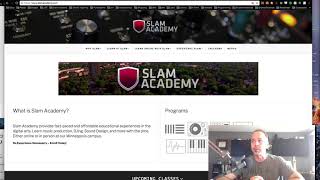
J. Anthony Allen built Slam Academy from a 2012 storefront into a multi-studio music school doing $500,000 in annual revenue with four full-time staff and ten contract teachers. When the music industry collapsed in the 2000s, he diversified into licensing, publishing, and teaching. He runs the school alongside freelance work and a publishing company.
Chapters
All right, so before we dive in and get down to the nitty gritty stuff, let me tell you a little bit about me. I come from a music background, and you're gonna hear a lot about music in this class, because that's what I know. Well, you could say that the first businesses I started were bands, which doesn't make a lot of sense, perhaps, but when you start a band and. And the band starts getting a little bit of work and doing well, you have to start thinking like a business. And I kind of got into that. You know, I was a musician, and I went to school for music and did all the music stuff. But musicians are forced to be entrepreneurs with very little training. And so there's a lot of falling on your face. There's a lot of trial and error. There's a lot of things you figure out how to do wrong before you figure out how to do it right. So, you know, I was in the music industry for quite a while, and there was kind of a. Without going into a lot of detail about it, there was kind of a lot of. There was. There was kind of a big collapse of the music industry around, oh, about the 2000s through 2010 or so. And then the. The Internet kind of killed the music industry for a while. But what emerged from the ashes of that was a music industry in which you didn't have to be famous to make a good living doing music. You had to have a little bit of an entrepreneurial spirit. But as long as you knew some kind of basic rules of running yourself like a business, you could make a living, and it's still that way. There's a lot of people I know that make a living as a musician. You've probably never heard of them, but they write music and they sell that music to TV shows, to commercials, to video games. And I'm one of those people, too. That's one of the several things that I do. I still produce music for various occasions, and I really solo stuff. If you search on itunes or Spotify or whatever, you'll find music that I've released. But what I also found while doing this, I found all these opportunities for income that were not just playing gigs and were not just writing music. It was, you know, starting a company, doing this or that. And through doing that, I got really involved in the business world and kind of the entrepreneur scene, I like to call it, in my city. So I'm based in Minneapolis, Minnesota, in the United States. And there's a lot of interesting stuff happening here, as there are in Just about every city, there's a community of entrepreneurs, there's a community of people, you know, raising money and facilitating, raising money for projects. And I found that my music background suited me really well to this community and to get these companies started. So I'm gonna tell you about a couple things I have going on right now. One is just myself as a freelance artist that is a business that I run. I have a publishing company that publishes my own music. Doesn't really publish music of anyone else, but it also releases albums. In music you have to have a publishing company. It sounds weird, but it's a long story that we don't need to go into, at least not right now. So running myself as a business, my creative output is one of my key income streams. And I like to talk about income streams, meaning basically the different businesses I have going. An income stream just means like I have income coming in from, you know, five different places right now. And one might do good in a month and one might do bad in a month. But hopefully it all equals out to keep me about the same what I make every month. And that's so far true. They're essentially separate businesses. So another company that I started is this one that we're looking at here on the screen. This is a company called Slam Academy. And what this is is essentially my own little music school that has grown to be not just my own little music school. So a little background on Slam Academy. It was started in 2012 or so. We got a little shop, a little storefront in downtown Minneapolis. And now we've moved to a bigger space. We have a studio complex that has four studios in where we teach classes and lessons in all kinds of stuff, but primarily related to electronic music. Slam academy has four full time employees, five, I should say just hired another one full time employees, about 10 people on contract. Those would be essentially my teachers, people that I hire in to come in and teach a class just on contract. So they're not employees. I just pay them for a gig to do the job and then several partners that help us out as well. Those are sort of like contract employees, but kind of on a longer term basis. We always have a handful of interns coming in and out, probably about four or five at any given point. And those are paid interns. I don't like having free interns and we'll talk more about that later. My personal philosophy on that. And then just because, you know, in this class we gotta get down to the nitty gritty and I don't want to keep Any, you know, I don't want to be shy about anything. So I'm just gonna tell you some, some back end stuff about Slam. Slam Academy does about a half million a year and, and that's pretty good. I'm pretty okay with that. You know, it means I get a decent salary. My full time people are paid pretty well. I don't think anyone's getting rich from Slam Academy, but it's a good job. My employees I think are treated really well. They have a nice benefits package and a very respectable salary. You know, my goal is for have us to do a million by the end of this year. It's about halfway through the year now. We might make it, but that's what I'm hoping for this year. We're definitely on track to do about 750,000 this year. It's been a big growth year for us so hopefully we'll definitely hit that. Maybe we'll hit a million this year. So Slam Academy is an educational place. We do online classes as well, which is a big thing as you know, because you are watching an online class. Making online classes is a big part of my income. That's a whole separate income stream for what I do and Slam Academy facilitates that quite well. So throughout this course I'll be talking about Slam Academy a lot, how it works under the hood, how it came to be doing, how it's doing, mistakes I've made, things like that. I have other companies as well, but the main one that I want to focus on is Slam Academy because I don't feel all that shy about giving you some of the insider financial stuff and all that kind of stuff. The other companies that I have, I am one of several partners in and they might, my partners might not want me divulging that information. There's also investors and other stuff like that. Slam Academy does have some debt right now. We managed to get through our first five years without any, any debt. Right now we do have about 20,000 in debt from a big project we did. We did a big promotion push. We had advertisements on television which are still running as of right now. And you know, we did a big outdoor concert. We did a bunch of stuff just to really get awareness of our brand up and it went pretty well. But we took out a little bit of debt to do that, but it's nothing I'm too worried about. I think we'll have it paid off in the next month. So that's kind of my background. That's where I come from. But I've also Studied business and entrepreneurship and I know about a lot of other markets as well, but a little bit about me. That's where I'm from. So with that, let's move on and let's talk about the format of this class, kind of how we're going to organize things.
This is Slam Academy. We're a diverse family of working musicians with one important common bond. A deep love for the creative process of making music.
I hate every preset I've ever listened to. I just want to like make all my own sounds. You have to have your own sound, otherwise you're not going to stick out.
United by our passion for creating, the slam family exists to educate and support musicians of any age, any level and in any genre.
Had been more to creating electronic music.
Once I stepped into sound design, I
was like, this is electronic music. This is like what I envisioned it being like.
Our community lives on and offline with live streamed group classes as well as in person programs in Minneapolis. Our instructors meet you where you are and work to accelerate your musical journey to where you want to be.
It was like frustrating in college being with all the music majors. You know, you had all these classical musicians and I'm like over here making beats and I, I come here and I feel like these last nine months I've learned more, way more for what I need to be doing.
With detailed courses in DJing, music production, recording, sound design and more, Slam Academy is ready to show you what it takes to be an industry professional.
I was pleasantly surprised with how much I really could take away. After only 12 sessions, I finished up
and I am walking out with exactly
the tools that I need to finish projects.
We want you to become a part of the Slam Academy family.










