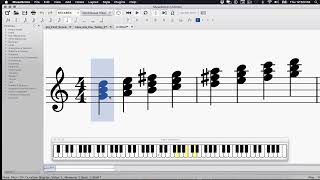
In this instructional video, J. Anthony Allen reviews how to derive diatonic chord progressions from a major or minor key. He first demonstrates the G‑major scale and shows two methods for finding its diatonic triads: (1) memorising the quality pattern (major, minor, minor, major, major, minor, diminished, major) and applying it directly to each scale degree, and (2) constructing each triad by stacking every other note of the scale. While building the chords he explains the “sharp‑carryover” rule, where a sharp introduced earlier in a measure applies to all subsequent notes of that pitch class. He then repeats the process for a minor key (E minor), highlighting the altered quality pattern (minor, diminished, major, minor, minor, major, major, minor) and showing how the fourth and sixth degrees become A‑minor and A‑major respectively. The lesson concludes with a brief teaser that the next video will explore the church modes.
Chapters
Okay, let's do some diatonic chord progressions. Now remember what these are is this tells us all the chords in A key. So let's go back to G major. So I'm just going to make a G major scale first. Okay, Now I have a G major scale. Now in order to make the diatonic chord progression, what I have to do is, is, well, I can do this in two ways. One is I can just remember the pattern. The pattern is major, minor, minor, major, major, minor, diminished major. Knowing that pattern, I don't have to plug in all the notes. I can just go through here and say the chords that fit in this key are going to be a G major, an A minor, a B minor, a C major, a D major, an E minor, an F sharp diminished and a G major. Because I can just apply that pattern of major, minor, minor, major, major, minor diminished major to the scale and know all the possible chords in the key. If I don't want to do it that way, I want to do it the long handed way. I can plug in all the notes. So let's do that really quick. So what I'm going to do is I'm going to take every other note of the scale. So this is going to be my first note of my first chord. I'm going to skip a note and then I'm going to go to B. So I'm going to put a B here. I'm going to go from B, I'm going to skip a note and I'm going to get to D. So I'm going to put a D there. Now that one's done. Now I'm going to go to the next chord. So this is A. So I'm going to skip a note and go to C. Put one there, go back to C, skip a note. I get to E and put that there. So I'm just going to keep skipping notes. C, D, skip E, F sharp. There's my F sharp. So now to C, skip a note to E, skip a note, I get to G. D, skip a note, I get to F sharp, F sharp, skip a note and I end up G. I have to go to the next. So I was on F sharp, I skipped G and I actually have to go to A. So I'm going to circle back around. Here's G. A is the next note. So that's what goes there. Put an octave higher. E. I'm going to skip F sharp. I'm going to go to G now. Sidebar. Why did the sharp disappear from this note? It's still an F sharp. Remember the rule on sharps carrying over. So this note has a sharp on it now which means all Fs in this bar are sharped. So this one doesn't need a sharp symbol anymore. We just know that it's sharp because there's one earlier in the measure. So this sharp applies to all Fs. So. So just remember that. So G. I'm going to go down here, G, skip A and I'm at a B. So I'm going to put a B up here, F sharp. I'm going to skip G and I'm going to end up on an A. From circling back around, I'm going to skip B and end up on a C. Then G. Let's go down here. I'm going to skip A, end up on a B. Now I'm going to skip C and end up on a D. There. So now if I did this right, my first and last chord should be the same. G, B and D. Go up here an octave higher. G, B and D. So I did it the same. So here's what that sounds like. All our chords. So those are all the triads that work in G major. So we can now go back to our pattern. Say G major. These are all the notes of G major. And the next one is minor. The next one is minor. The next one is major, major, minor, diminished major. So all the notes in C major are those. All the notes in D major are those. Because the pattern still works. Okay, now let's look at it in A minor key. The pattern is slightly different. Let's go down to our E minor, F sharp, remember. Alright, now let's not write out all the notes this time. Let's just use the pattern. So the pattern is minor, diminished major, minor, minor major, major minor. Okay, so if I'm in the key of E minor and I want to think what chords will work in E minor. I want to build a chord on a. A. What's that going to be? It's going to be a minor chord. So you're going to want to put an A minor chord in there. Because the fourth degree is A and that's a minor chord in the key of E minor. Okay, if you want to build a C chord in the key of E minor, are you going to make it A major or A minor chord? You are going to make it a major chord. Because the sixth scale degree in the key of E minor is, is A major chord. So you just apply the pattern to the scale and then you have the diatonic chord progression, which tells you all of the possible chords in that key. Major or minor. Both work, but they have different patterns. Okay, I think that's all the review we need. Next up, we're gonna dive into modes sometimes called the church modes, really historically rich music and also relevant to modern music as well, so let's dive into those right now.