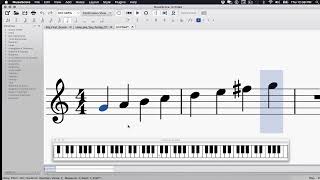
In this instructional video, the instructor provides a concise refresher on major and natural minor scales, assuming viewers have completed earlier music theory lessons. He demonstrates how to build a G major scale by walking through the whole‑step/half‑step pattern (W‑W‑H‑W‑W‑W‑H) and explains each interval with piano examples. He then constructs an E natural minor scale, outlining its distinct pattern (W‑H‑W‑W‑H‑W‑W) and emphasizes that E minor is the relative minor of G major because both share the same key signature (one sharp, F♯). The concept of relative keys is highlighted as a crucial tool for later, more advanced material. The video concludes with a brief teaser for the next review video on diatonic chord progressions.
Chapters
Okay, let's do some super quick review. Now, we've done a lot of music theory so far. I'm assuming, and probably will continue to assume for this whole class that you've taken either my first three music theory classes in this sequence, or you at least looked at them enough to know that you could skip ahead. So I'm going to kind of assume you've been through that. I'm going to do two review videos right now. Now, even if you're comfortable with this stuff, humor me and watch these review videos, because a little review never hurts. And these two topics, I'm not going to review everything that we've done in the last 100 and some videos of the other three classes. But I want to review two things that are going to be critical to us going forward in this class. And. And so in this first review video, we're going to talk about major and minor scales. Really quick because I want to get back into your head how we find those scales. Because a lot of what we're going to do in this class is going to be looking at some other scales. And knowing how our major and minor is determined is going to help us to understand those other scales really well. So let's make a major scale, and let's not make a C major scale. Let's do something different. Let's do a G major scale. Okay? So my first note on my scale, if I'm just going to play all the notes in order, is going to be the one it's named after. So if I'm making a G major scale, the first note is going to be G. And now I have to go through this pattern, right? So do you remember the pattern? The pattern of this scale of a major scale is whole step. So that's going to be to A. And remember, it's a whole step because there's a note in between. I can put a G sharp or an A flat in between these two notes. If we're looking at a piano, in fact, let's do it. So here's the note I just played. Here's our G, and here's our A, right? G and A. There's a note in between G sharp or A flat, right? So that means since there's a note in between, that means the distance between these two is a whole step. The distance between these two G and G sharp or A flat is a half step. And the distance between G sharp or A flat and A is a half step. But G to A is a whole step. Okay? So let's go through and get rid of these notes. Okay, so G a whole step, right? A to B is also a whole step, right? Because there's one in between. So another whole step and then a half step. So our pattern so far is whole step, whole step, half step. And this is a half step because B to C, there's nothing in between. Okay, so then from C it's another whole step. And then to E which is another whole step. And then from. And then our next step is a whole step. Our next note is a whole step away. So E to a whole step higher, it's going to get us to an F sharp because we need one in between for it to be a whole step, right? So E to F is only a half step because there's nothing in between. So we have to go to F sharp for a whole step. So that note is the next in our pattern. And then our last one is a half step. So the pattern is whole step, whole step, half step, whole step, whole step, whole step and then a half step. And that gets us a major scale. Okay, now let's look at a minor scale. Well, let's hear that first. Okay, good. Happy major scale. Lets do a minor scale. Okay, what minor scale should we do? Oh, let's stick with the theme and do an E minor scale. Now why did I say we're going to stick with a theme and do an E minor scale? Hold on to that for a minute. We'll come back to that statement in just a second. So the pattern for an E minor scale, this is natural minor, by the way. Now remember, there's a couple different flavors of minor. This is natural minority. So our first note is a whole step away. And if we start on E to get to a whole step, remember what we have to do to go to F sharp? Because E is here. This E is here to F is only a half step. So we have to go up one more to get to a whole step. Okay, and then from here we go half step and then whole step, and then whole steps and then whole step and then whole step and then whole step. So that gets us back to E. So whole step, half step, whole step, whole step, half step, whole step, whole step. That is our minor scale pattern. Let's hear it. Okay, so that's an E minor scale. Now why did I say we're sticking to the same theme? Because we have one sharp here, an F sharp. Right? And in the key of G we had one sharp. In the key of G major we had one sharp. So that means G major and A minor or G major and E minor are what they are relative keys. Remember we learned that word, so that means that they use the same key, key signature, or the same number of accidentals. G major has an F sharp in it, which means it has no F natural in it. And E minor has an F sharp in it, which means it has no F natural in it. They're all the same notes. If we started the scale here and went up to G, we would just start. We would repeat E and F sharp at the top and we'd have G major scale. So it's all the same notes, just in a slightly different starting point. E minor, G major, relative keys. Remember that? Okay, so that's your quick review of major and minor. Next, let's review our diatonic chord progressions. I know you're sick to death of hearing about diatonic chord progressions, but it's going to be worth it to do one quick review of it before we dive into some of the fairly complex things we're going to do with that sucker in this class. So let's do a quick review of that in the next video.