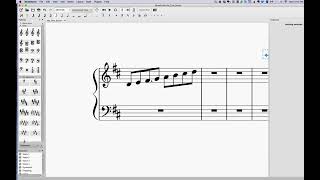
In this lecture, J. Anthony Allen provides a concise review of the seven diatonic modes, emphasizing their sequential order (Ionian/Major, Dorian, Phrygian, Lydian, Mixolydian, Aeolian/Natural Minor, Locrian) and how each mode can be derived by starting a major scale on successive scale degrees. He demonstrates the process using a D major scale, mapping each degree (E, F, G, A, B, C♯, D) to its corresponding mode (Dorian, Phrygian, Lydian, Mixolydian, Aeolian, Locrian, Ionian). Allen briefly mentions an alternative conceptual view—e.g., Dorian as a natural minor with a raised sixth—and stresses that remembering the order and the shifting‑note method is sufficient for mastering modes. The lecture concludes by signaling a shift to a review of First Species Counterpoint rules, framing them as foundational for the upcoming advanced counterpoint material.
Chapters
Okay, let's do a quick review on modes and how modes work. Do you remember the order, the order of notes in the modes? So it goes, the order is major and then Dorian is the second one. Phrygian is the third, Lydian is the fourth, Mixolydian is the fifth, Aeolian is the sixth. And remember that's the same as the normal minor scale. Aeolian Locrian is the seventh. Remember that's the goofy one. And then we're back to the major scale. So that's the order. And we can use the order if we, if we just find a major scale. So here's our C major scale. Okay? And now we know we remember that from C to C, the key signature of a C major scale. Actually, let's do this in a different key. Let's do D. So I'm going to make a D major scale. Okay, So I have a D major scale here. Now D to D and the key signature of D major. Okay? So now the modes are. This is the major scale. So the modes, if we start on two. So E to E is a Dorian scale. F going to be our Phrygian scale. Let's go back here and add an F on the top. Okay, F to F is our Phrygian scale because it's the third. So it's going to be an F Phrygian scale. G up to G is going to be a Lydian scale because it's the fourth one. It's the fourth note of the scale. So we take the fourth. The fourth mode, that's Lydian. So G to G in this case is going to be Lydian. A up to A is going to be Mixolydian scale. B up to B is going to be the Aeolian scale, or in other words, the minor, the relative minor. C up to C in this case is going to be the Locrian scale. Remember it's actually C sharp up to C sharp because of our key signature. C sharp up to C sharp is going to be the Locrian scale. And then we cycle all the way back to D, which is going to be the major scale again. So that's how we can find the modes very quickly. Now remember, there's also another way, the way where you can say, well, the Dorian scale is a minor scale with a raised six or whatever scale you're. You're looking at. Review those if you want, but remember that you can always find the modes this way. Most important thing to remember about the modes is the order of them and how this process works of shifting the notes and cycle circling around. If you can remember that, you'll remember all the modes just fine. Okay, with that, let's review the rules of First Species Counterpoint again, because these are going to be the building blocks for everything we do in this class on Advanced Counterpoint. So let's go back and look at the First Species Counterpoint rules one more time, and then we'll press on to the new stuff.