Ableton, Logic, Pro Tools, FL Studio - Which should you pick?
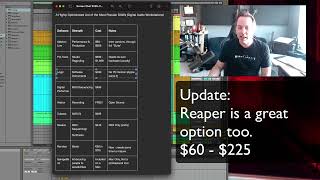
J. Anthony Allen surveys nine major DAWs, ranking their strengths: Ableton for live performance, Pro Tools for studio recording, Logic for software instruments, FL Studio and others for different workflows. He shares a bad experience with Pro Tools tech support and promises a follow-up with budget-based recommendations.
Chapters
Okay, so I'm gonna go over this list. This is, you know, this, this kind of all changes fairly, wildly the cost. So look up the cost before you make any real decisions. This is just kind of what it is lately. And there's a couple things that I've left off this list just because I didn't think of it when I was making the list, but now I'm thinking of it. So I'll talk about those in just a second. So we're going to go over this list and then in the next video, I'm going to tell you, just for the money, here's what I would do. Okay, so first, let's talk through this. Okay, so I've listed here a bunch of the different DAW applications. Kind of what a big summary of their strengths in my mind. The general cost and some notes about them. Okay, so Ableton Live, I've already talked about its strength is performance and production. This performance thing means that it has the ability to, like, if you see somebody like DJing live, they might be using Ableton Live because it's really the only one that has that built into it, the ability to use it as a performance tool. But it's also really solid for production. The cost ranges between $99 and 699 because they have different versions. There's an intro version and then what they call a standard version and then what they call the suite. So the suite is 699, the intro is 99. If you want to do professional work, you kind of have to have the suite, I think, but you can always upgrade. So getting a smaller version and then upgrading to a bigger version is cheap. So something worth considering. Okay, next on the list, Pro Tools. Its big strength is recording. I find a editing and working in Pro Tools to produce music, to generate music to be really cumbersome and somewhat frustrating. But to record it is kind of the industry standard right now for a big recording studio. They're probably going to be using Pro Tools. Okay. It also has various versions, so it's between 699 and up to 2,000. It usually needs its own hardware, which makes that price jump a lot. Like, if you get one of the big Pro Tools HD systems, it's going to be up in that 10,000 or more range. The other thing I'll add about this, based on some recent experience, is that Pro Tools, the parent company of Pro Tools, is Avid. Avid. Avid, is the company that owns Pro Tools. I was recently doing some work with Pro Tools and some Pro Tools hardware, and I Had to deal with their tech support, which I was warned against doing because people had told me how just utterly horrible their tech support is. But I had no choice and I went to their tech support and I can confirm it was one of the worst experiences of my life. So I really don't advise anyone using Pro Tools anymore because their tech support is so awful that I just don't think any human should be treated that way, to be honest. So Pro Tools, not my favorite. Okay, moving on. Logic. The big strength of logic, I think is software instruments. Meaning if you want to simulate the sound of an orchestra, logic is really good at that. It's really good at making things sound real. And you can do that in any of these programs. But it's really just kind of built into logic that you can cue up an orchestra that's going to sound pretty real. So it can handle a lot of what we call virtual instruments all at the same time. So it's quite good for that. The cost is $499, I think. I recently saw this down at $299, maybe even $199. Maybe it was a sale. No, there's no PC version because Apple owns it. Okay. Digital Performer is really good at MIDI sequencing. It's good at other stuff too. Digital Performer just is not very popular. I don't know why. It's made by a company called Mark of the Unicorn. It's a great program. It's great. It's just, I think it just didn't make it into any of those kind of hipness categories. So it's not particularly fashionable. But yeah, it's a solid program. Ardur. So Ardor is basically a Pro Tools clone. So it's designed to look and act like Pro Tools. It's open source and free. So that means that Ardor can be a little tricky to set up, although it's gotten a lot better. But it's a full featured program. It's totally free. Check it out, you might like it. I know people, professional producers that use Ardor. So it can be a great option. It's got, you know, if something is open source, that means that usually that means that their tech support might be non existent. But there's usually a really big community of users who are willing to help you if you have a problem. So check it out. It's worth considering. And I believe it's for Mac and PC and like Linux and some other weird platforms. Cubase. Similar category to Digital Performer. It's a great program. I don't have any problems with it at all. It's not as hip as anything else, but a lot of people are using Cubase and having great results. So check out Cubase if you like Reason. Reason is a weird program. For a long time, Reason only did MIDI sequencing and synthesis, but it was really good at synthesis and it still is. I think you can do audio sequencing now. Sequencing means, like, moving stuff around in time, but that's relatively new, so if you're really into synthesis, then Reason is good for that. But it's not very popular because for a long time it was basically only a synthesis tool and wasn't a full featured daw. Again, I think it is now, but has kind of fallen to the bottom of the list because for a long time you weren't able to do full projects in it. Renoise is a weird one that I just thought I'd throw on there because I kind of like it. It's a weird program. It's really fun for making beats. It's really cheap and I just wrote that it's new, it needs some time to mature. At this point, I don't really think it's all that new anymore, but it's kind of neat. And GarageBand. It's good at introducing people to possibilities. It's free on a Mac, but there's no PC version of it. And it's not really a professional tool, but it's just kind of. It's kind of great for like, introducing people to what you can do on a computer with music, but it's not. You can't really make professional quality work on it because it just kind of. It's got a lot of, like, training wheels on it, so to speak. It doesn't let you have full control over the program. Notably left off here is FL Studio. FL Studio is really popular with dubstep people and other people. A lot of EDM stuff. It's probably comparable to Ableton Live. I don't know what it costs, but it's on Mac and PC now and it's a great program. It works a little bit differently and I don't know it all that well. I have poked around with it a little bit and what I see in the interface is a little confusing to me. So I think it's different than some other programs, but they're all slightly different. It definitely has that hipness thing to it. If you're on a PC especially, and if you want to make dubstep or anything similar to that, then FL Studio might be kind of your go to thing, so it's definitely worth considering. Okay, so this is my kind of highly opinionated list, but let's go into. Let me just tell you what I think you should get. If you don't have anything and you're just getting started.










