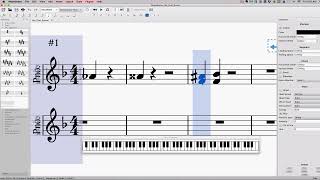
J. Anthony Allen explains augmented and diminished intervals as larger or smaller versions of standard intervals, using double-flats and double-sharps that shift pitches by whole steps. An augmented third (F–A♯) sounds identical to a perfect fourth (F–B♭), though they're spelled differently. These rare intervals appear mainly in complex, chromatic music rather than pop.
Chapters
Okay. We have major intervals and minor intervals. We also have things called augmented intervals and diminished intervals. You can think of an augmented interval as like a super major interval. It's a little bit too big to be a major interval and a diminished interval as kind of like a super minor interval. It's a little too big or a little too small to be a minor interval. Now, in order to fully explain these, I want to look at two new symbols that we've never seen before. We have them right up here. That's this symbol and this symbol. Let's do this one first, because it's a little easier to see. Let me put a note down here. Now, we know this symbol means flat, right? And that means we go a half step down. This symbol means exactly what it looks like. It means double flat. That means two half steps down, a whole step down, right? So a single flat means down a half step. Two flats means down a whole step. Now, pitch wise, what is the difference between an A double flat and a G? Because an. A double flat. Let's look at our keyboard here. Okay, so here is. Here is our A right here. So a single flat puts it here. A double flat puts it here, right on a G. So what's the difference between an. A double flat and a G? Nothing. They're gonna sound the same. They're gonna sound exactly the same. They are both, sonically, meaning the way we hear it, they are both a G. But sometimes we have a need to do this double flat kind of thing, and there are reasons that we need to do it. It's fairly rare in modern music. It's extremely rare in pop music. But sometimes it does exist, and we can go the other way as well. This symbol. Let me put another note down. Here's an A. This symbol means double sharp. Now, why do we have that symbol instead of just two sharps? I don't know. Somebody came up with this symbol. Maybe having two sharps side by side was ugly or hard to read or something. I don't know. But we use this symbol to mean two sharps. So that means it's up a whole step. Okay, so this is where our. We start scratching our head. Let me do a third. This is a major third. Okay? F to A. What if I did this F to A sharp? It's not in the key of F. The way. I could also write that is like that These two things are going to sound exactly the same. We'll get back to double flats and sharps in a second. Just hold on. Trust me. So these are going to sound the same because A sharp and B flat are the same note. But what do we call these intervals? The technically correct thing to call these intervals is this one we would call an augmented third. And this one we would call a perfect fourth. I know, right? Why, that's just nuts. That's just the way it is. Sometimes there are reasons where you. Where you do this, but this is spelled as a third. So remember, it's two spaces top and bot. You know, two spaces. So it's a third. There's no denying that. That's a third. We put this accidental on it. And now the only thing that's up for debate is what kind of third is it? So it is an augmented third. This is a fourth because we have the interval of a fourth here. The accidental on it, which is B flat because of our key signature, makes it a perfect fourth. But this is a fourth, and this is a third. The accidental makes us an augmented third. Let's look at this one. B flat, remember the key signature. And D, this is a major third. Okay? B flat to D is a major third. What would happen if I did that? Now, one flat would make this a minor third. Two flats make it a diminished third. It's like a super. It's like super flat, kind of. So what would be the difference between that and this? B flat. And C is a major second. This is a diminished third. Nothing. Sonically, they're going to sound the same because a B double flat is a C. Sorry. A D double flat is a C. Here's a D flat, double flat. That's a C. These double flats and sharps are just kind of. You know, there's a part of me that wants to say they're just kind of dumb. But when you start to write really complex music and really weird keys, they do have a need to show up Again. They're not used in. In pop music or anything like that. Very rarely will you have a need to write a double flat or a sharp. But they do exist. So here we have a diminished third. Because if we look at it, that is a third, right? That interval is a third. The accidental makes it a diminished third. All right, Those are augmented and diminished intervals. We'll keep an eye out for them. It makes things a little trickier. But remember that in general, when you encounter an interval, it's going to be major, minor, or perfect. Like 90% of the time, 99% of the time, every now and then, you're going to hit one of these augmented or diminished intervals. If you see a double flat or a double sharp, that's a good indicator that you're looking at an augmented or diminished interval. But sometimes you can do it without a double flat or sharp like this one. So we just got to keep our eyes out for those. More on that in the near future.