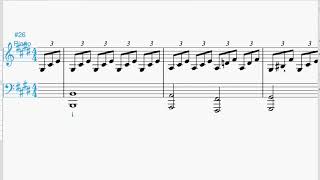
In this instructional video, J. Anthony Allen uses the first four‑and‑a‑half bars of Beethoven’s Moonlight Sonata to introduce the Neapolitan (♭II) chord. He begins by establishing the key (C♯ minor) through the key signature and the opening C♯ minor triad, then examines successive harmonies: a C♯‑E‑G♯ triad with an added B (a 1‑7 or 1‑4‑2 inversion), an A‑C♯‑E triad functioning as the vi chord, and finally a D‑F♯ chord with an F♯ bass that does not belong diatonically. Allen identifies this D major chord as the Neapolitan (♭II) chord, explaining its theoretical role and how the accidental B♯ later reinforces its function. The video emphasizes chord spelling, scale‑degree analysis, and inversion labeling, and sets the stage for a deeper dive into the Neapolitan’s harmonic implications in a follow‑up video.
Chapters
Okay, let's introduce the Neapolitan chord by looking first at one of its most famous examples. So you know this piece before or you've heard this piece before, probably. This is Beethoven, Moonlight Sonata, the first four and a half bars. Okay, so not too much. I'm not going to make you listen to the whole like hour long thing. So what do we have here? Let's just quick take a look at what's here. We have a key signature indicating E major or C sharp minor, if you know how this song sounds. And we look at this big C sharp right here, you're probably thinking C sharp minor. And you would be right. C sharp minor is really where we're at. Grave here. Or grave. This is a tempo indication. This means really slow, like grave. Dead, dead slow. I don't think that's really how it translates. But really slow. Okay, so we have, we see a whole bunch of arpeggios in the right hand. Things getting a little weird. Right in this bar we got a B sharp that's a little fishy, some accidentals, and then we end right there. So let's just hear this little excerpt. Let's try to get it all on one page here. There we go. All right. Here we go. All right. And then that's where the melody comes in. So somewhere in here is one of these goofy Neapolitan chords. So let's do an analysis. Let's get through the first couple things here and then we'll jump over to a new video once we get into that, the gnarly stuff. Because the first couple things are quite simple actually. Right, so let's take a look down here. Okay, so we are clearly in C sharp minor. Okay, so let's just do that. And then let's say what is our first chord? Probably a big old one. Okay, we have C sharp here. What are going to be the notes of C sharp minor, C sharp, E and G sharp. So we have G sharp, C sharp and E right there. So we're just spelling a good old C sharp minor triad over and over. Okay, so now what do we have here? We have C sharp, E, G sharp. We still have the C sharp minor chord, but we've added a B to it. So it's still kind of a I, but it's got a B. So what is B in the key of C sharp minor? What scale degree is it? It's the seventh, Right. Or in A minor key. So it's that flat seventh, but. Or I shouldn't say it's A flat Seventh. It's a natural seventh in this case in this key. But it's not a leading tone, right? It's not a half step away. That would be a B sharp, which. Oh, remember, we're going to see a B sharp up here. That's a good clue as to what that's doing there. But we can call this a 1 7, though. So this really kind of is a 1 7, but let's call it more accurately what it is, which is a 1, 42 chord. So that's our inversion. So meaning that if we just wrote this chord out, let's go out here, Say, what chord is this? It would be. Let's just write it out in kind of a root position. So B, C sharp, E, G sharp. That's what the chord is. So we would call it a 4 2. Because there's our 2, there's our 4. Technically, it's a 6, 4 2. But we leave the 6 off, remember? So it's a seventh chord. It's a 17 chord. But let's call it a 142 chord because intervals or inversions are going to get important. Okay, so now let's go on to the next chord. So what do we have here? We have A C sharp and E. Without looking at the bass note, just looking at these three, can we tell anything about what that is? A C, E. Right. A C sharp, E. That's an A major triad. A C sharp and E. This is also an A. So pretty solidly, these two beats are A, C sharp and E. So an A major. So in the key of C sharp, minor. What is that? Is that something in this key? It is, actually. It's nothing very weird at all. It's our six. Okay. Nothing strange there. So I seven to vi. A little strange to go from a seventh chord to. I mean, normally if we saw a I seven, we would kind of assume it's a secondary dominant. But remember, we're in a minor key here. So this is a minor seventh chord, not a dominant seventh chord. So it doesn't have that same tendency to resolve that the dominant seventh does. Okay, now we get to this guy. So what do we have here? We have a D natural and F sharp. So if we put these into a chord, we have D, F sharp. A makes a D major chord that works. That's a chord. D major. We have an F sharp in the bass. So that still supports our D major chord. So let's just write D major because what is D major in this key of C sharp minor? Nothing. Doesn't exist. Because if we remember the diatonic chord progression in minor, we have made. Or we have minor major. Major. So the second chord is major, but it's built on D sharp. Right? This is just a half step away. So can we call this. Flat 2? Does that make any sense? It's a bi chord. That's what it is. Right. It's a II chord built on the flatted root. So is there another thing we could call this? Kinda. I don't know why my text is glitching out that way. But. There is another thing we can call this. We can call it a Neapolitan chord. We don't really put the exclamation point in there, but. Okay, so let's go to a new video, and let's analyze this as our first big Neapolitan chord.