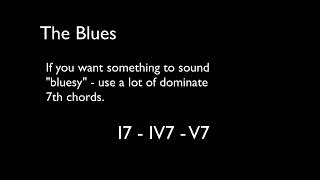
The blues uses dominant seventh chords on the I, IV, and V, adding a flat seventh to each. This flat seventh note sits outside the key but creates the blues sound. Unlike classical music, these chords don't resolve traditionally; the blues keeps the tension.
Chapters
Let me tell you one more use for a dominant seven chord. In a genre like the blues, we use seventh chords for just about everything. Your tonic chord, you add a minor seventh to it. To your V chord, you have the dominant seventh chord. And the four chord, you add a flat seven. So all of the chords you use are that dominant quality. So that means it's a major chord with a flat seven. That's what makes a blues sound, is you use the I chord, the IV chord and the V chord, and you put that flat seven, the minor seven, on all those major chords. That is the blues. In terms of chord progressions, there's more to the blues than just that. But if you want that sound, you don't resolve those dominant sevens correctly, right? Because the 1, the 5, 7, the dominant 7, should not resolve to the 1 with a flat 7 in it, right? It should resolve to a 1, not a 1 with a flat 7, because that's a note out of key. But that's okay. That is what the blues is, though. The blues likes just to add these sevens and treat everything like a dominant chord, a major chord with a minor seventh on it. So when I say flat seven, what I'm talking about is that major chord with a minor seventh on it, even though it takes it out of key. That's just what makes the blues sound like the blues. So another use of the dominant seven chord.