J. Anthony Allen teaches how to label harmonic intervals in two-part counterpoint using simple numbers: write 3 for a third, 6 for a sixth, reduce compound intervals to their simple form, and use U for unisons. He walks through a concrete example identifying sixths, thirds, fifths, and octaves, then explains the basic rules of contrapuntal motion and the importance of using the correct clef when notating.
Chapters
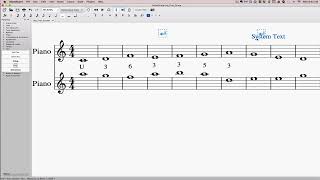
Okay, up next, we need to talk about connecting harmonic intervals. So harmonic is the vertical interval here. Now this is what's tricky about counterpoint is that there are rules for the melodic line. There are rules that both lines have to follow and vertical intersections as well. So this becomes like a jigsaw puzzle of making sure the rules work both ways. So I have here a simple two part counterpoint. So two new words for us, homorhythmic and polyrhythmic. This is just talking about the rhythms that we're going to be working at. What we see here is a homorhythmic piece, meaning there are two lines, right? There are two melodic lines here on two different staves, but there's only one rhythm. They are moving in a unison rhythm. Right? Everything is half notes. So a piece that is homorhythmic means that everything that's happening is moving in the exact same rhythm. The alternative to that would be polyrhythmic. That would be where one line has a different rhythm than the other. Okay, so polyrhythmic music, you can do counterpoint and polyrhythmic music and we'll look at that later. But as we learn the rules, we're gonna just be looking at homorhythmic music for the first little bit here because it's just easier to see the intersections of them. Right, cool. So two new words for you regarding rhythm. Okay, so here, when we look at something like this, here's how we analyze it. What we're going to do is we're going to write the names of the intervals between the notes. In this case, we'll do it in between the two, right in the center. Okay, so I'm just going to. Because we're all diatonic here, there's nothing out of key. You don't really need to write whether it's a major or minor interval or a perfect interval. All we do have to write is the number here. If there's no major or minor on it, we assume that it's in key. Okay. So typically when you're doing this kind of analysis, you don't write like if. When we get to a third, like here, here's a third. Let's do that. So what would we call this one? We would really just call it a three because it's a third. And. And whether or not it's a major or minor third in this kind of analysis doesn't matter. It's a diatonic third. That's all we really care about for this kind of analysis. So if you encounter anything out of key, you do have to label it, especially anything that's augmented or diminished. Now, one other rule about this is that any compound intervals, we reduce to less than an octave. So if we encounter a ninth, we're going to write it as a two, because we're going to get rid of the octave, we're going to reduce it to the smaller interval that uses the same notes. And this is just how we analyze counterpoint, typically. Right? So this is what you're going to encounter in your theory books. So let's keep going. Let's keep analyzing this. Okay, so what do we have here? We have an A and an F. What is that interval? That's a sixth. So we're going to write a six there, and a C and an E is a third, and a D and an F is a third, and a C and a G is a fifth, and an F and an A. Now, this one is actually a compound interval, right? There's an octave in between here, but we're just going to write it as a third, because that's the rules for this kind of analysis. Here we have a G. Let's slide over a G and a G. So there is an octave in between here. But for this one, we are going to write eight for octave because we want to separate octaves in unison. So let's just write eight for octave. Here we have a G and an E. That's going to be a sixth, and a B and a D. That's a third. And we're back to a unison. So for unison, we usually just write a U, not a one. I don't know why, it's just the way the rules work. Okay, so here's our interval analysis, our harmonic analysis so far. Okay, so that's step one. What we need to do next is learn how to write the counterpoint. If this top line is our cantus firmus, what are the rules governing the direction that each note can go? Right, what we know is we don't have any dissonant intervals here. That's what we've just learned. Right? We have sixes, thirds, fifths and octaves. Nothing. We don't even. We don't have any fourths. And remember, fourths can be allowed in the right context, but they're kind of the weird one. But we don't have any seconds, we don't have any sevenths. None of our dissonant intervals have shown up here. So this is good. So next, let's talk about contrapuntal motion. Right, but, hey, first, let's hear this, because I haven't let you hear it yet, and that's not fair. Okay, before we hear this, let's point out one major error that I made. Did anyone notice it? This is actually kind of a humiliating error because I can't believe I just did that. So through the magic of editing, you didn't see me fix my error and correct it. But you know what? I'm just gonna own it and admit it, because, you know, everyone makes mistakes. What I did is when I set up my two staves here, I made two treble clef staves, and then I entered all the notes that I wanted in bass clef. So all these notes were wrong. They looked right, but I had the wrong clef here. So what I did is I switched this to a bass clef, and then I got the notes back to where they were so that it would be correct. So what I should have done from the get go was just put a bass clef here. Because normally when we see these things, we see them as bass clef and treble clef. I was going to do it as two treble clef things, and then I forgot what I was doing. So basically, I entered all the notes in the wrong clef. It happens. So I'm going to edit out my discovering and correcting of that. But I thought, you know what? I'll just own it and admit to you that sometimes we make mistakes with clefs. It happens. So now we are in bass clef. We are in the correct clefs. Let's hear it. Sa.