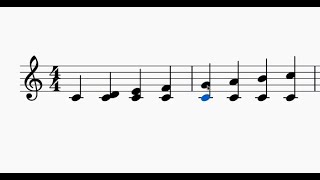
J. Anthony Allen explains consonant intervals as pleasant and complete, while dissonant ones feel unfinished and need resolution. The fourth is tricky: it sounds consonant when played melodically but acts as dissonance harmonically, resolving down to a third. Dissonance isn't bad, just unstable.
Chapters
Okay, it's time to talk about another aspect of intervals that we've touched on here and there. It's come up, but I want to focus on it specifically here. And that's the idea of consonants and dissonance. This is an important role in music. And it comes with a couple new vocabulary words, I suppose, modifications of vocabulary words that we already know. So first let's define consonant and dissonant. So consonant, consonant. We can kind of say it has a pleasurable sound. Let's not even say pleasurable. Let's say it has a. A sound that we could walk away from. Like, the sound happens and we're like, okay, that's a nice sound, and we walk away. Dissonant would be the opposite of that. And that's something that has a more stinging sound. Something that doesn't feel like it's finished is a good way to put has somewhere else to go. I like to think about dissonant intervals as incomplete. In other words, they are on their way somewhere but not quite there yet. And so they have this dissonant sound. So let's look at all our possible diatonic intervals. So that means all the intervals in key. Here's a super easy way to do that. Let me give us a little more volume here. I'm just going to make a bunch of Cs, and then I'm going to put a major scale above it. So let's leave that one like it is, because that's unison. Okay, here's all our diatonic intervals, right? Because here we have essentially a unison here, a second, here a third, a fourth, a fifth, a sixth, a seventh and an octave. Okay, we're going to talk about more than just diatonic intervals in a second. But let's start with those. Those. So let's just hear this just for fun, Okay? Kind of neat. Now, we have some intervals that we call a perfect consonants, and we have some that we call an imperfect consonants. Now, nearly all of these are consonants because they're diatonic. So perfect consonances are going to be more or less our perfect intervals, right? So unison, fifth, an octave. Now what's the perfect interval that I skipped? The fourth. The fourth gets treated kind of weird with this idea of a perfect consonant, the fourth, generally speaking. And this really changes by the century. Like composers of certain centuries treated the fourth as a perfect consonance, and some. And then another century, they didn't treat it that way. Generally speaking, when we see the fourth as a melodic interval, meaning like, so one note after the other, we consider it a consonance. When we see it as a harmonic interval, we hear it as a dissonance. Now, that's kind of. That's super subjective, right? Like, it's hard to call this a dissonance, right? Because it sounds pretty good. The reason that I'm willing to call it a dissonance is because of this. Watch. I'm going to hit a couple of these. And then I'm going to resolve it to there. So what it can feel like is that this harmony is on its way to this one. Because when I play it, you're going to hear this and then it's going to. This note is going to fall down to this E, and you're going to say, oh, yeah. So this was on its way to that. That felt like a resolution, which we're going to talk more about in a second. But let's just hear this, right? So it kind of feels like this is on its way to that. So that would make this a dissonance. And it's a consonance. It's not a very sharp dissonance.