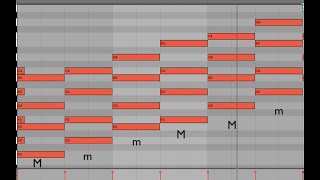
J. Anthony Allen breaks down seventh chords in major scales: major seventh, minor seventh, dominant seventh, and diminished seventh. Learn the interval makeup of each, notation conventions like M7 and m7, and how the seventh adds color and jazz flavor without changing the chord's basic quality.
Chapters
Because of our diatonic chord progression, we know that that's major. Our seventh is from here to here, a major third. And our root of an F would be an octave higher right there. And that's only a half step away. So we know that this must be a major seventh, another one of the really pretty ones. Now, the fifth, the V chord, is where we get that weird dominant situation where we have a minor or, sorry, a major triad. But a minor seventh, that's just what is naturally occurring. And we call that a dominant chord or just a shorthand, is a seventh chord. When we talk about a seventh chord, the kind of common lingo we use is if It's a major seventh chord, we write this M, a J7. If it's a minor seventh chord, we write this lowercase M, and then a 7. If it's a dominant chord like this, we just write the letter or the number 7 after the chord name. So in this case, we would write G7, meaning that it's a G major triad with a minor seventh on it. Okay? So that's the one exception. That's the one place in the scale that that's going to show up. Let's move on. Our VI chord is a minor chord, and it has a minor seventh on it. The root would be here if we took it up an octave. Our B chord, this is our diminished chord, right? So this is a minor. Actually, this is a major triad. So this. This one is just all kinds of weird. So let's just continue to call this diminished, but we'll call it a diminished seven in this case, because what we have is a minor triad with that major third. But it's a major third here. But it's a minor third here, right? So that's just all kinds of weird and goofy, and it sounds ugly. So we don't often use it in popular music or electronic music or really very much. We tend to avoid this like the plague. It's just not very useful for us. So file that one away for now. We're still going to call it a diminished chord. Let's call it a diminished seventh chord. Let's do. Let's hear it. I'm going to get rid of all our sevenths. Okay, let's get rid of those and hear it, and then we'll play it a second time and I'll put the sevenths back in. So here it is without the sevenths. Here it is with the sevenths, Okay? So you can hear, hopefully, that the chord quality is unaffected. It's still a major or a minor chord. Adding the seventh just gives it a little more color, Right? It's a little more colorful. It sounds a little bit more jazz. Like, to me, chords that use a lot of seventh or music that uses a lot of seventh chords tends to be. Have a more jazz flavor to it. So if you want that kind of sound, add a bunch of seventh chords to your harmony. If you don't want that kind of sound, don't. Now, there is a special reason why we might use this dominant chord, so I want to put that into a little bit of context and focus on that quickly. So let's do that in the next video.