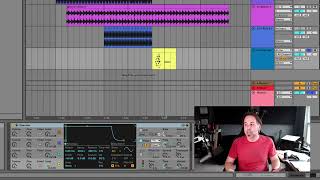
J. Anthony Allen breaks down how synthesizers work as mathematical equations that produce sound, covering five main types in Ableton Live: subtractive synthesis filters rich harmonics, physical modeling emulates real instruments, FM synthesis modulates oscillators for 80s textures, wavetable synthesis creates dubstep sounds, and sampler synthesis shapes audio samples.
Chapters
Okay, different types of synthesis. You can think of a synthesizer as a big math equation, okay? So the result of the equation is generating sound. How the equation works is the type of synthesis, okay? So there's a number of different types, types, a number of different ways to get the solution that is the sound, right? And depending on what type of equation you do, you will get different kinds of sounds. Now, don't worry, you don't have to do any math here. The software does all the math for you. You just get to twiddle knobs. But underneath all of that is basically complicated math doing different things. So there's a few different types of synthesis, and we have a good representation of several types built into live. The most common types, in fact, almost all of them, I think. So we have something like analog, which looks like this. This is what we would call subtractive synthesizer. That means that it generates sound, a complicated sound, and then we use some things to chip away at that sound, to leave us what we want. So we make a complicated sound, and then we pull layers away, we subtract them, and that results in the sound that we want. Another type that we have a lot of in live is a physical model. Physical model is like trying to emulate something in the physical world, like. Like a xylophone, right? So on a xylophone, we hit little wood bars with a hard mallet. That's how. That's how a xylophone works. So we have basically that whole instrument wrapped up into this giant equation, and that lets us control different elements of it. Physical models are going to get you fairly realistic sounding sounds. They're going to sound like real instruments in the real world. Unless you do weird things with physical models, then you can make very unreal sounding sounds, which is where they get really fun. Another one is fm. If we look at our operator synthesizer, this is. This synthesizer actually can be a few different types of synthesis, depending on how we set it up and how we use it. But the most common use of it to me is as an FM synthesizer. FM is where you have something that makes sound, something else that makes sound, and you use that other thing to mess with the first thing, and you might have a third thing, and you use that to mess with the second thing, which is messing with the third thing gets kind of weird. But FM synthesis is a sound that will be really familiar to you once we start working with it. It's been very popular, basically built the 80s and is still cool, in my opinion. The last kind of big kind of synthesizer that we have here is the new one, and that's wavetable. This isn't new in live 11, it was new in live 10. Wavetable synthesis is a bit more complicated and it's where you get those really gritty sounds. Like if you want that kind of gnarly dubstep like sound, that's like wavetable stuff. Serum, which is very popular plugin right now, is a wavetable synthesizer. So we'll go over how wavetable synthesis works and how to make those big gnarly sounds with it later. It's capable of a lot more than that. And then we have samplers, we have a few built into live, and they are synthesizers, strictly speaking. They have a sound generating component. And then the other components that we need, they're just kind of a different kind of synthesis. So samplers take an audio sample to generate sound. But then we have a lot of controls over that sound once it's in there. So we can still do things like we were just talking about shaping the timbre, the shape and the motion of the sound. So samplers are a different type of synthesis, kinda. So those are the different types of synthesizers we'll be working with. Those are the ones built into Live. We'll be going through each one shortly.