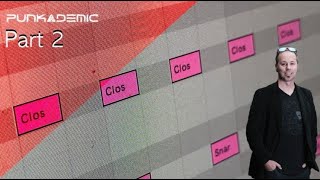
The video opens with promotional testimonials about Slam Academy’s community, mission, and educational offerings, emphasizing a supportive environment for musicians of all levels. J. Anthony Allen (Jay) then introduces the second installment of the Drum Programming Masterclass, focusing on samplers, the MIDI grid, and genre‑specific drum pattern creation. He explains that while he demonstrates using Ableton Live (with a brief look at Logic), the concepts apply to any DAW. The lesson covers how samplers differ from simply placing audio clips, the auto‑mapping of drum racks, and routing effects (delay and reverb) via return tracks. Jay walks through building basic drum‑and‑bass, dubstep, and trap patterns, dissecting song examples, adjusting note placement (e.g., shifting a hi‑hat hit to the second eighth‑note of the third beat), and applying effects to specific elements. The segment ends with a brief playback of the constructed four‑bar pattern, reinforcing the idea that many valid approaches exist for creating drum‑and‑bass beats.
Chapters
Hi, my name is Jay and welcome to Slam Academy.
This is Slam Academy. We're a diverse family of working musicians with one important common bond. A deep love for the creative process of making music.
I hate every preset I've ever listened to. I just want to like make all my own sounds. You have to have your own sound, otherwise you're not going to stick out.
United by our passion for creating, the Slam Family exists to educate and support musicians of any age, any level and in any genre.
Had been more to creating electronic music. Once I stepped into sound design, I was like, this is electronic music. This is like what I envisioned it being like.
Our community lives on and offline with live stream group classes as well as in person programs in Minneapolis. Our instructors meet you where you are and work to accelerate your musical journey to where you want to be.
It was like frustrating in college being with all the music majors. You know, you had all these classical musicians and I'm like over here making beats. And I come here and I feel like these last nine months I've learned more, way more for what I need to be doing.
With detailed courses in DJing, music production, recording, sound design and more, Slam Academy is ready to show you what it takes to be an industry professional.
I was pleasantly surprised with how much I really could take away. After only 12 sessions, I finished up and I am walking out with exactly the tools that I need to finish projects.
We want you to become a part of the Slam Academy family.
Hey everyone. Welcome to Drum programming Part two, Samplers and sequencing. So in this course, we're going to be building on where we left off in the first course. And specifically we're going to be focused on using samplers and the MIDI grid. Now you can use whatever software you want to. In this course, I'm going to be using mostly Ableton Live a little bit of logic. But the concepts that we talk about here will apply to just about any audio program. So you don't need to be using Ableton. We're going to talk about how samplers work, the differences between using samplers to trigger drum samples and just placing the audio files on the grid like we were doing in the last class. We'll also dive into a number of different genres, kind of continuing the tradition that we started in the first class. Specifically in this class, we're going to spend time building drum and bass patterns, dubstep patterns and trap patterns. So we'll dissect a couple songs, we'll look at how those worked, figure out how to make some of our own music in that style. And in general, just keep on practicing, making really great drum patterns and beats. I hope you decide to join us. It's going to be a really fun class. I'll see you on the inside. It. Auto mapped. We say the mapping will be set up automatically with the drum rack. Usually, not always, but most of the time. So I'm gonna record a little beat. So I'm gonna do what I did before. Now I want you to notice one thing. That delay on it. Let's put it just on the hi hat here. Okay. So in order to do this, we're gonna put our delay actually onto this, this return track. Okay. So now I have a reverb and a delay. Let's just turn that reverb off for now because I'm not going to need it. Just want this delay. When we think about dubstep, we might be thinking that we have this really bombastic sound. But a lot of that is in the bass. The drums are actually relatively simple. Let's go up to where the drums really kick in to 13.3. That's the second eighth note of the third beat. So instead of right on the third beat, we're gonna push it back just a little bit. And then my snare, I'm gonna leave right where it was. Okay, that's it. So one thing I should mention. There are tons of different ways that you can come up with a drum and bass beat. Right? There are a lot of different ones. There's not just one. This is a very basic drum. Drum and bass beat. Okay. So I'm gonna. Okay, all the stuff down here is the same four bar pattern. And I'm got kind of frantic hi hats going all over the place. Let's hear what we've got. It.