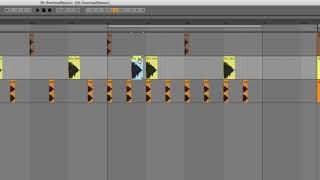
J. Anthony Allen shows how to make programmed drums sound human by adjusting volume on individual hits. Alternating quiet and loud hi-hat notes removes the "clunky, rude" feel, ghost notes add subtle snare echoes, and an extra kick on the "and of four" resets the groove.
Chapters
Okay, next let's talk about some of the most basic techniques we use to liven this up. Okay. And the first one I want to talk about is dynamics. So dynamics is fancy word for volume. Now you might think making this louder or quieter isn't going to change how cool or not cool it is. And you would be right. However, that's not what we're talking about. What we're talking about is changing the volume of different elements at different times. Okay, so check this out. Let's go back to this one. Right? Okay, so this hi hat is just clunky and rude in many ways. I don't know why rude is the right word, but it just comes. That just feels rude to me. But let's take our volume. Okay. And I'm going to automate this volume. Now this is where if we were working in a MIDI setting, this would be a little bit easier. But what I'm going to do is just put a little mark in between all of these. So this line is my volume, right? So I'm just going to automate the volume here. So I'm just going to take this one down, Maybe not that far. It's going to kind of approximate. And let's take this one down too, actually. So, and then let's leave the next one up so it's going to be too quiet. And then one louder and then let's leave this last one loud. Okay, so quiet, quiet, loud, quiet, quiet, loud, quiet, loud. Okay, so I'm just turning some down and leaving some loud. Okay, let's hear what we've got now. Right, Totally made it way less rude. Okay. We could even pull this volume up a little bit so that it wasn't so quiet. Although I kind of liked it down there. If we were working with midi, we would just adjust the velocities of these and it would be quite a bit easier. Less cumbersome I should say. But this does the same effect, Right? Not bad. So just by adjusting the volume of some of the notes, we give it a much more natural feel. Right. Think about the way an actual drummer would play that kind of pattern. Right? They their right hand would be hitting the hi hat if they're right handed, I suppose. And they're gonna naturally put some accents on beats. Right? So we want to emulate that and it gives it a much natural feel. Much more natural feel by emulating just the way that a drummer would work. Drummers are always putting accents on stuff and we want to do that too. And we don't really want to put an accent on the snare here, because we only have two of them. So putting one louder than the other doesn't really make a lot of sense. But if we had more snare hits. Let's do it. Let's put a snare hit right there. Now, I want that to be on the of 4, which it's not quite. So my sample is a little too long, so I need to shorten it to get it right there. Right on the OF four. Okay, now it's there. Okay. Now if I just play this, you're going to hear two loud sample cracks right next to each other, which isn't going to be awesome, but we can fix that with velocity. So let's hear it first. Right. Not awesome, but let's take that first one and drop it down to be quite a bit quieter. Maybe somewhere around there. Right now it's got a much more natural feel. We would call this a ghost note. Okay. A ghost note would be like a snare hit or really any kind of hit that is right before or right after a normal on the beat hit. But the ghost note will be off the beat, usually on a 16th note and much quieter. Right. It's almost like an echo of the note. And we could put it after, like. Let's do one after right here. That one doesn't sound as good. I like it before better than after. Cool. Not bad. So the next thing I'm hearing, I'm kind of imagining hearing that I'd like to hear is another kick. I'm not going to do any accent work on the kick, but I really wish there was a kick right on the and of four. I think after this hit, having an extra kick here to reset us back into there would feel kind of good. I often like a kick on the and of four just as a taste thing that I like. So let's see what we've got now. Right. Not bad. So we took this really bland and what was the word I was using for it? Rude beat. And we turned it into something much more interesting. Really Just using velocity is all we've really used here. Or not velocity necessarily, but volume dynamics. That's all we've really used here. I added one snare hit and turned it way down. I added one kick and didn't do anything to the velocity, to the volume, just because that's what I felt like doing. And I'm the teacher, so I can do that. But the majority of the feel here that we've created is with the hi hat and adjusting the volume. Okay? So don't forget about that. That's a big, big distinguishing factor when you're making these patterns. Some variation on the volume. We'll talk more about this as we get into building some beats in particular styles. But for now, just remember dynamics.