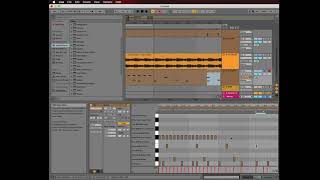
J. Anthony Allen builds a trap drum pattern from scratch, starting with a basic kick-snare loop and layering in claps, doubled kicks, and hi-hats at 140 BPM. The key is programming hi-hats with mixed 8th, 16th, and 32nd-note subdivisions in a semi-random pattern across four bars to get that frantic trap sound.
Chapters
Okay, let's talk about trap. Now, just like dubstep, there's a lot of different styles of trap that can happen, and it can be to put our finger on one thing that is like the definitive beat of trap or the definitive drum pattern of trap is quite tricky to do do. So what we're going to do is the same as before. I'm going to do something that I think is pretty much indicative of the general style of trap. And then we'll pick apart some songs and see how it fits together. So let's go back to starting with our basic. Basic drum pattern here. So I'm going to make one bar. Let's loop that one bar. Let's get rid of that weird thing I just made. Okay, so we're going to have kick on 1 and 3, snare on 2 and 4. Still getting some of this. Delay. My send was still up just a little bit. Should be gone now. Okay. And then let's put some hi hats on 1, 2, 3, and 4. Okay. Oops. I made a poke. Because we're going super duper fast. Okay, let's double up our hi hats. There we go. Okay, so now let's see how we can turn this into something more like a trap pattern. Now, if you listen to trap music, you know that a lot of trap comes down to these hi hats. And we want those hi hats to be pretty darn frantic. But we'll get to hi hats in just a second. Let's start by. Let's double up our kick. I'm going to move. We're going to go half time again. So I'm going to move our snare over to three. Okay. Because we're going to crank up our tempo. And then I'm going to put another kick on four. And then let's put something on two. Maybe a clap. Let's just say that's actually not bad. Let's use this snare. Okay. So now we have this. Okay, you're thinking. I don't know. I don't really hear trap there. Just hold your horses. Okay, let's extend this out to be two measures long. Okay. And let's keep going. So we're gonna keep our. We're gonna keep part of our pattern going. These two things are gonna be the same. I'm gonna put those on 2. 2. But we're gonna keep adjusting our kick a little bit. So let's maybe go here, Here, two, three, there. Okay. And then let's just carry our hi hat over as a placeholder for. Okay. Not Bad. Let's put this up at a. At a more trap friendly tempo. Let's try 140 or so. Okay. Not bad, right? We're getting there. Now what I really want to do is extend this out to be a four bar pattern. So let's actually do it because we do have it kind of continuing on. So I'm going to make this four bars. Here's our third bar. Here's our fourth bar. Okay, so let's look at what we've got here. So third bar, I'm going to go here. I'm going to go three, four. I'm going to go four, two. And we're going to go second half of four, three. Okay. And then we're going to keep these right where they are. Okay. And then let's extend these out. So now we have a four bar drum pattern. Okay. It's kind of a two bar pattern. It repeats a little bit. Oops, still looping. Just two bars to extend my loop out to the full four bars. There we go. Okay. Not bad. Okay, now let's deal with these hi hats. Now what we really want here is some hi hats moving at about this speed. And we want some hi hats moving crazy fast. The way to do this is, you know, you gotta zoom way in. You know you're going to do some hi hats that are just really cruising at 32nd notes. I wouldn't go all the way up to 64th notes, which would be this. That I think is too fast because I'm at 64 right now. That's what my grid looks like. I don't think we want 64. Definitely not at this tempo. So 16th notes, 8th. 8th notes, 32nd notes. That's really what we're looking at here. And you're gonna kind of really randomly disperse them. There is some logic to it, but as far as I can tell, and I'm not a scholar of trap music by any means, it's pretty just kind of like really delicately placing things in somewhat of a random way. And it's reasonably time consuming. So here's what I'm gonna do. I'm gonna get rid of that. I'm going to go out here to the magic of television where I've already made this. It's like a cooking show where they like turn around and say, I've already made the souffle. So here's one where I like really tediously put in all those hi hats exactly where I wanted them. So let's take a look here. Okay. So I've got some going at eighth notes here. Here's 32nd notes. Or I guess these are 16th notes. No, these are eighth notes. These are 16th notes. And so different sizes. If I zoom out, you're basically just getting a ton of stuff. Okay. All the stuff down here is the same four bar pattern. And I'm got kind of frantic hi hats going all over the place. Let's hear what we've got. Alright, not bad. So check out just how to do these hi hats. You really just have to get into the grid and really make them kind of changing up and moving around a little bit. But that's our basic trap pattern. So with this, let's go on and analyze a couple tracks, see if we can make this or something like it fit into some other songs.