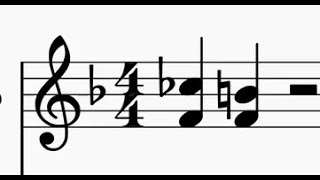
J. Anthony Allen explains enharmonic equivalence: notes that sound identical but have different names, like C♭ and B, or E♯ and F. He plays examples so you hear them, then points you to a worksheet for practice.
Chapters
Okay, one more vocab word I want to give you, and that is. Or actually, it's a term, not a word. It's two words. Enharmonic equivalence. You're gonna hear me say this from time to time. We've already learned what this is. In a case like this, A C flat and a B natural sound the same, but are written differently and kind of function differently. That idea of a note that sounds the same but is written differently, we call it enharmonic equivalence. Enharmonic means we can spell it multiple ways. We can spell it two different ways. Equivalence means the same. They are equal, so they sound the same, but are written differently. So any two notes, for example, let's do F and G double flat, are enharmonically equivalent. Those two notes, because F is going to sound like F and G double flat is going to sound like F. Okay, I could do this also. Watch this. Let's just get weird with this. E sharp is enharmonically equivalent to F and G double flat. Right? Because E sharp is going to sound like an F, and that's going to sound like an F. These are all enharmonically equivalent. Can I do any others that sound like F? I could do a D double sharp is only going to get me to an E. You can do triple sharps sometimes. They're extremely rare, and I don't even want to put that into your head, but let's do this. Another G double flat, another F, another E sharp, another F, and another G. I just want to point out kind of the silliness of this. Okay, so I'm going to play these two bars, and you're going to hear enharmonic equivalents. That is enharmonic equivalent. All of these notes are enharmonically equivalent. F sounds like F, G flat, G double flat sounds like F. E sharp sounds like F. They're all enharmonically equivalent. So that's the fancy term we use for that. Cool. I just want to be sure we got that vocabulary word in there. Up next, I have another worksheet for you to go over all this interval stuff, so let's check that out. Please use it to practice. And then we're going to go on and talk about consonants and dissonance, a very fun topic in the next segment.