First Species Countpoint: A Quick Review
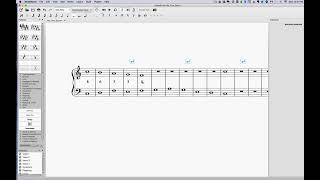
J. Anthony Allen reviews the rules for first-species counterpoint: the counterpoint line must start and end on unison or octave, align with whole notes of the cantus firmus, and use contrary motion. Avoid parallel perfect fifths and octaves, limit perfect intervals, and don't repeat a note more than twice.
Chapters
Okay, I have here for us a countous firmis. And let's write a counterpoint to it using first species counterpoint. Now, first species counterpoint means we're going to add a whole note. We're going to add one note for every note in the cantus firmus. And the first thing that we remember is that our first note has to be an octave or a unison. And in rare occasions, we can do a perfect fifth. But really we want an octave or a unison. So let's do. And whoops. Let's do an octave here. And now the next thing we remember is that our last note has to be an octave or a unison as well. So let's throw that there. Now going through it, Remember the different kinds of motion we can have. Those are going to be really important in this class. Contrary motion is our favorite. So that means that if this is going up in the cantus firmus, we have to go down and we need to make an interval that works. So our interval here we would call an 8. Even though it's two octaves, we would still just call it an 8 because we reduce it to 8. So that's an 8. What happens if I go down to a B here? That gives us a six. An interval of a six here, which is good. It also gives us contrary motion. So let's label these as we go here. Okay, there's an eight and a six. Okay, what next? Let's try to do contrary motion again. So what note would go good with an F. And be going down? So an A. An A would work splendidly. An F and an A is a major third. It makes contrary motion, doesn't repeat notes. I think that is awesome. Okay, so let's put a third right there. A three right there. Because it's third. Remember that. We just write the number here. We don't write if it's major or minor. We just care about the interval. Okay, can we do contrary motion again? This one's going down. So we would go up. Can we go up? Let's try it. If we go up, what do we get? Get E to B. That's a fifth. Now, fifth by itself isn't terrible, but it makes us like one foot in the grave when it comes to do we have parallel fifths. So we kind of want to avoid that. So I'm gonna see if we can get away with doing a similar motion kind of movement here where we go from a third down to another third. And that's okay. Remember, we can repeat intervals. That's fine. We can have parallel motion like this, and it's allowed as long as we don't do it all the time. Two in a row are good. And is this similar or parallel? Let's see. It's a major third to a minor third. So it is similar motion, I believe, because this one only went down a half step and this went down a whole step. Okay, let's see what comes next. This one is going up, so if we can go down again, we would be good. So what will be going down? Oh, let's do an octave. That would be. It's a nice landing point. Now, remember, again, the rule with octaves is we don't want a ton of them, but having an octave in the counterpoint somewhere is okay. All right, now we're going up. So if we can go down, down, we would be good. Let's try to get to. Well, what happens if I go down a step? I've been doing it all this whole way. We have a G and an E. That's a six. That's okay. Let's put a six there. Sixes are allowed. What next? We're going up to an E. Can I go. Or, sorry, up to an A. Can I go down to a D? Not really. That's going to get us into a fifth again, a perfect interval situation, which we want to try to avoid. So let's see if we can do another similar motion. If I go up to F, I have another sixth, and sixes back to back are just fine. So we can get away with that. That's perfectly allowed. Okay, so I have this nice kind of line here. I've gone down now I've gone. I've switched directions. I wonder if I can keep going up. If I go up here, I land on an octave and that's okay. Octaves are okay as long as we don't have millions of them. They kind of thin the sound out, so we don't love them, but they're. They're. They're good. In this case, I think the benefit that we get of having this line go down by the scale and then up by the scale will be better than. Than the negative side of having these octaves here. Let me say that again in a better way. These octaves are not awesome, but this line going all the way, going down by scale and then back up is awesome. And I think this is more cool than. It's cool enough to let me deal with those octaves, so I'm going to allow it. What next? I'm going down to An E. Can I go up to an A? Not really. That gets me to a fourth, which I really don't like. Remember, fourths are like really kind of a. No, no. So could I go down to an F? Then I have an E and an F. That's a second. That's definitely a no, no. So we've got one other option that we can do is we could try to just stay put. Could stay right on that G. That gives us an interval of a third, And that's okay. Remember, this is oblique motion. So this one didn't move. This one did. It made a new interval. It doesn't create any parallels. Remember, the rule with repeating notes is, is that it's allowed to repeat a note. It's not allowed to repeat a note three or four times. As long as the note keeps moving, it's okay to do a repeated note once or twice. Okay, let's see if I can keep going up in my counterpoint here. I'm down to a D. Can I go up to an A? No, I can't step just up to an A. That would make the good contrary motion. But that lands me on a fifth, which I don't love, especially since if I was a fifth here, I'd be going from a fifth to an octave, which would create a hidden octave. So let's not do the fifth. Let's jump up to a B, though. That gives me a six, which is okay. And then I resolve on an eight. So this is a six and this is an eight. Okay. So that made this nice line where we go down by step and then up, stay the same small leap and then to the octave again. Let's hear it. Okay. Pretty nice. I think that sounded great. Let's hear it a little faster just so that we can maybe hear that line a little bit better. The top line, the counterpoint might become more clean or more easy to hear if we speed it up just a little bit. So let's try that. And there you have it. So that was a quick refresher on counterpoint. First species counterpoint. Now let's jump into some rules of second species counterpoint.










