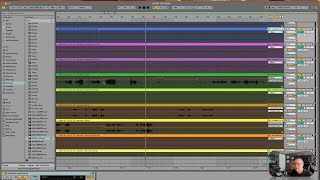
In this segment J. Anthony Allen explains his recent work creating music and sound design for narrative, primarily sci‑fi, podcasts. He walks through a real Ableton Live session that contains separate vocal tracks recorded by actors, layered sound‑effects tracks, and his own musical pieces (mostly MIDI). Allen emphasizes the critical role of automation—subtle volume fades, boosts, and reductions—to balance overlapping dialogue, raise quiet words, and ensure each character’s voice is clear. He demonstrates how small automation curves (the pink lines) are used to fine‑tune the mix, and shows how his MIDI‑based music is placed within the larger session. Throughout, he conveys enthusiasm for the creative process, describing sci‑fi sound design as a “dream job” and highlighting the satisfaction of seeing a full, complex session come together.
Chapters
So one of the things I've been doing for the last year or two is contributing music to podcasts. There's a couple of podcast companies I work with where I'm writing the music for their shows. Primarily narrative shows and primarily Sci Fi stuff, because that's the things I find really fun to work on. Doing sound design for Sci Fi is like, dream job. So here is an episode of a podcast. You can see if I go all the way to the end. It's pretty, like 40 minutes long. I don't even remember this one. Oh, this is a really short one. This is only like 15 minutes long. But it's a narrative. And you can see what I have here is I really have all the different vocal tracks that were recorded by the actors. And then down here we have some sound effects, and then at the bottom we have music that I wrote for it. So it's just little chunks of music here and there. But you can see in this whole thing how important the automation is. So here I'm just fading out the volume. But as you mix something, you really have to do a lot of delicate automation, especially when it's a narrative like this and there's, like, multiple people talking over each other. So anywhere you see this pink line, there's some automation in it somewhere. So looking at this section, you can see it's just very subtle things that happen when you're working on anything, music or narrative or anything. So I believe these are all just volume. But here, you know, the volume of this character needed to come down just a touch. This one came up just a touch. And then this word. It looks like we wanted this word to be, you know, comparable volume. So I just boosted that word because it was recorded quietly and the actor must have turned their head away from the mic or something. This is how we fixed that. It turned out, you know, really quite nice. Station's over. We don't need sarcasm at a time like this. Oh, wow, Hannah. So, you know, it's neat. So it's a big session. Here's some musical thing I wrote for them, and then a couple other music things. So the music, it looks like, is just MIDI stuff. That's actually it. Let's listen to what's at the end of this. Did it just. I'm afraid it did, yep. Just pissed on him and blew up. Look out the window Is it afraid it is. Mars is no longer our discovery Gone Ayden you. Pretty simple. But, you know, it's nice to see a whole big kind of session like this with all these actors going and then looking at how the music gets placed and put together. These are from projects. I like doing them.