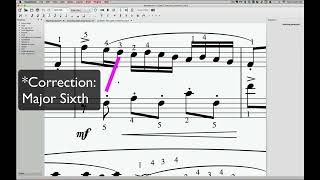
J. Anthony Allen analyzes vertical intervals in Bach's Two-Part Invention No. 8 in F major, identifying each interval as notes overlap across eighth- and sixteenth-note values. He names major sevenths, minor sixths, fourths, fifths, and others, explaining which are consonant or dissonant and how they typically resolve.
Chapters
Okay, next we want to talk about analyzing intervals. So I just want to talk about. We look at a piece of music and we go through it looking for just intervals. What are we looking for and how are we identifying them? There's a couple tricks to it. So I have here one of the Bach two part inventions. These are great for analyzing intervals because it's really just two lines all the way through. This is number eight of the two part inventions. Now, the first thing I want to point out here is this is piano music. You see all these numbers here? If you're not a piano player, you're probably like, what are all these weird little numbers here? These are finger numbers. So these are fingerings. From a music theory perspective, we can ignore them. They don't really mean anything to us. They tell us how to play it on the piano. So I'm going to be ignoring those numbers. But if you sit down to play this, that. That'll be a good help to you and what you should do to play it. Okay, let's hear this short little piece. And then I want to talk about how we would analyze some of the intervals here, Sam. Okay, let's have a look here. So what I want to look at here is really just the vertical intervals. That's things. Things like right here, right here. And actually right here, you're like, no, there's no other note that goes along with this one. Yeah, but there is. Let's zoom way in here. Okay, so let me first take a peek at our key signature here. B flat. Okay, so we're in the key of F. We have one flat. So we got to keep that in mind while I'm zoomed way in here because I can't see it. Okay, so here's an F against nothing. So no interval there. I'm also going to peek at my clefs here. Treble and bass. Okay, so here we have an E and an F. Okay, so that is the interval of what? We have an F on the bottom and an E on the top. That's a major seventh interval. Okay, so what? So our major seventh interval is a dissonant interval. Where should that go? In this case, the major seventh interval is going down to here. And this is turn. So the high note is going down to a D. So it's turning into a sixth. Now, if you're thinking this note is by itself, you're not quite right, because this is a 16th. These are 16th notes. This is an eighth note. So we have to consider that this note should still be ringing Even though it's marked short, we think of there being an F from here all the way to the next note. So this note is being played against an F because the rhythm here tells it to be longer than that. So this is a major seventh resolving to a minor sixth. And then we go to an A and a C, which is a third, which is a consonant interval. So that's okay. Then we have here an A against a D, which is a fourth. So that could be. Okay. Let's see if he resolves it to a third. He does. Okay, so this is where this gets interesting, because he does resolve it to a third A to C. However, the bass note has moved on by that point. So this is where a counterpoint gets really interesting. And we're going to talk a lot about counterpoint in the next section. But so basically what we have here is a fourth between this A and this D. And now we have an F and a C, which is a fifth, which resolves to an F and a B. Now, the fifth doesn't need to resolve, so that's okay. But up next, he goes to an F and a B flat, which is a fourth, and then from a C to an A, which is a sixth, and then from a C to a B flat, which is a minor seventh, and then an F to an A, which is a major third, and then an F to a G, which is a second, and then he resolves that to a unison. So this second second resolves down to a unison, and then it keeps going. So we could go through here and figure out every single interval and where it's going and what it's doing. But the key that I want you to remember here is that in a passage like this, it's not that this note is an interval and this note is not an interval, because nothing's here. You have to consider that this is also here. And this continues on this one continues on during this note, this one continues on during this note, and etc. Right. Let's see if I can find another example of that. I think Everything here is 8th notes or 16th notes. These obviously are note to note. Right. This is an interval. That's an interval. That's an interval. That's an interval, Yeah. Pretty much everything is eighth notes, but so this F we would compare against this B flat here. So keep that in mind when you look at intervals. Okay. I'm gonna give you this piece of music just for fun in the next section. And then a worksheet to practice some of your interval naming stuff. And then we'll move on and talk about counterpoint.