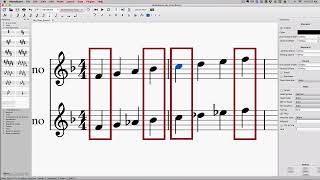
J. Anthony Allen explains why unison, fourths, fifths, and octaves are called perfect intervals: they stay the same in both major and minor keys. Seconds, thirds, sixths, and sevenths change between the two, which is why they're major or minor instead.
Chapters
Okay. So, as you know, because I've explained it a couple times, the fourth, fifth and octave we call perfect intervals. And the other ones are not perfect intervals. They can be major or minor. Let me explain this in a slightly different way. I'm still in the key of F here. So let me just write. Up here, I'm going to write an F major scale. Okay? Zoom in a little bit on that. Okay, now down here, I'm going to write an F minor scale. Okay? Zoom out just a hair. So, F major and F minor. Now, here's another way to look at our perfect intervals. Let's look at what notes are the same. So the root. This would be called a perfect unison. So, and this is technically a perfect interval, by the way. A unison is a perfect interval. The fourth is the same. It's B flat. Don't forget our key signature. The fifth is the same and the octave is the same. So our perfect intervals are the same in major and minor. Now, I know what you're thinking. If you are astute, and I know you are, you're thinking, what about this two? I thought the two could be major or minor. That's kind of the exception. The two can be major or minor. And it is the same between the two major and minors. So that is an exception. Think of it in terms of. We do find lowered twos like that in some of the modes and things like that. So it does exist in a major or minor. So it's kind of the exception. But the other ones are. Our third is different. Right? Our sixth is different, and our seventh is different. So those can be major or minor, and that can be major or minor, and so can the two. The two is, again, the odd man out there. So the perfect intervals, and we call them perfect intervals because if you go back to all the way back to, you know, Gregorian chant and things like that, they've been around for the longest. And they were considered the simplest and best intervals. So we call them perfect. They were unalterable perfect, just as they are the other ones. They came along a little bit later, and they had multiple ways you could do them. You could do them raised or lowered, and that made them changeable. So they had major or minor versions made. But the perfect intervals are still the perfect intervals. Technically, we have four perfect intervals in a scale. The unison, the fourth, the fifth, and the octave. Cool. So perfect and major and minor intervals.