How to Write 4-to-1 Counterpoint (Third Species Counterpoint)
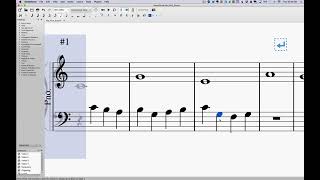
J. Anthony Allen teaches third-species counterpoint, where the counterpoint moves in quarter notes against whole notes. The strong downbeat allows only consonance, while weaker beats permit dissonance. Parallel perfect intervals remain forbidden, and stepwise motion is favored over leaps to prevent voice crossing.
Chapters
Okay, let's move on to third species Counterpoint. Now, like I said, this isn't three notes for every whole note. This is going to be a shocker. But it's four notes to every quarter note. It's actually sometimes called four to one counterpoint. So that means we still have our cantus firmus in whole notes, like I have here. And we use quarter notes for the counterpoint, like so. Now, this does just like when we did this before. And we're gonna start on a quarter rest. So just like before, all the rules of first species counterpoint still apply. All the rules of second species counterpoints still apply. And there are a couple more, not that many in third species. Actually, it does bring in a couple different wrinkles. Now, remember, our big wrinkle that we had to deal with in second Species Counterpoint was the idea of accented beats, right? And there are certain kinds of intervals that could happen on accented beats and certain kinds that could happen on non accented beats. So let me do one more measure here, just so that we can see a full measure without a rest in it there and there. Okay, that looks good. Okay, so let's just look at this measure here. How about that? Okay, so where is my accent? Now? Remember before in Second Species Counterpoint, my accented beat was the downbeat. My unaccented beat was the middle beat, right? Beat three in four, four time. Which is what we always do this in. But now I have these other ones too. So what's the game plan here? What's happening here is we have two different levels of accented beats. What's happening here? So we have our strongest accent here on the downbeat still always. Right. Strongest accent is going to be on the downbeat. We have a weaker but still accented beat on beat three now. And then we have our unaccented beats, our beat two and four. Okay, so this is an accented beat always has to be consonant. These are unaccented beats. They can be consonant or dissonant. And this one is an accented beat that behaves kind of like unaccented beats. So this one can be consonant or dissonant as well. So accented beat, less accented beat and unaccented beats is what we can call the three types of rhythms that we have to deal with here. Other than that, the intervals we can use are still the same. We're not expanding the intervals allowed at all. We have two new types of motion we can create other than, you know, we've got contrary motion, parallel motion. We've Got a couple new ones, two of them that arise because of the way things are working here. And we're going to talk about those two things in the next two videos. Our rules of parallel intervals still apply. And these are. The rule is the same, but it's a little more confusing. So check this out. Let me actually just do one more bar here just to make this more transparent. What's going on? Okay, so we cannot have a parallel perfect interval, meaning parallel octaves or parallel fifths between two adjacent notes. Right. So that's kind of impossible. Well, no, it could be possible here because we could go from a fifth to a fourth or something like that between two adjacent notes. That would create two perfect intervals, which would be a. No, no, we also can't have. Parallel fifths are octaves between downbeats. So basically between these notes. Right. So if we had an octave here and an octave here, that would be parallel octaves between the downbeats. No, no. So you've got to watch out for your downbeats all the way across. That makes writing this line to be musical a little trickier. Now, one of the ways that we can kind of simplify that is, is with some common practice things. Some things that we tend to do when we're working in third species counterpoint. Not necessarily rules, but good guidelines. One is think of as often as possible using steps in third species counterpoint. There's a lot of just scale patterns going up and down and things like that. So there's a lot of steps, right? We have a skip here and then a step all the way. So one skip and then a leap here. Leaps are fairly rare. You should never have more than one leap in a row. And you can usually get through a third species counterpoint with only using one leap. The main reason you would want to use it is you have to watch out for voice crossing. I don't think voice crossing is something we've talked about yet. But as we get more and more notes against our cantus firmis, voice crossing could be a concern. Let me show you what voice crossing is. That would mean, let's say this keeps going up. So let's say this went up to a D, this went up to an E, and this went up to an F. Okay, so this makes a nice line in our counterpoint. It's going up, up, up, up. And hopefully we can land on a consonant on the next note. If I keep going, it's not going to work because I'm going to have a G in the bass and an A Over there, that's a second. That's going to be a dissonant interval on the downbeat. That's going to be a big no, no. But let's not worry about that. Let's worry about this thing I just did right here. This is a case of voice crossing, which is not allowed. All that means is if we were playing this on a piano, we would have to cross our hands over. Right? Because this note and this note are the exact same note. Okay. So if I was to write this note in treble clef, it would be right there. It would be over here, but it would be the same note. Those are both E. That is a unison. So you can sometimes get away with the unison. That's not what's breaking the rule here. What's breaking the rule is this note. This note is in the lower staff, but it is actually above that note. So we've crossed over this note and now this note is higher than what's on there. That's a. No, no, we don't do that. That's called voice crossing. So when you're working in third species, sometimes you need to make a leap Here we made a leap down just to avoid getting too much higher. We've got a third in between these two notes. That's just fine. But if I went one more, we'd have a second. And if I went one more, it would be any unison and then we'd be in trouble. So a leap can get you out of a pickle with voice crossings. Consonant skips, quite rare, as I was just pointing out. Another thing that's fairly rare and should be. You should try to avoid is doing any kind of skip or leap across the bar line. Try to keep the bar line going step wise, either up or down doesn't matter. But we want a step crossing the bar line. Now, that's not a really strict rule. You can have one if it works. But we tend to like our notes to kind of walk into the downbeat in third species just by step right up in there. That means we have a little bit of planning to do right this note. If we go E, F, G. If I go up one more and step right in there, I can walk right into an A here. Let's do it. And that's going to be an octave with that note. And that works as long as I didn't create a parallel octave here, which I didn't. That's third. That's an octave. That's okay. I could have also stepped down.










