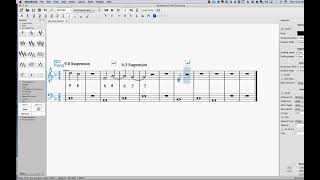
J. Anthony Allen explains consonant suspensions in counterpoint, showing only two are possible: the 6-5 suspension resolving downward and the 5-6 resolving upward. The 5-6 is unique because it's the only consonant suspension that allows upward step resolution, something dissonant suspensions never permit.
Chapters
Now, there's another kind of suspension we can do. We've looked at these where the rule is dissonance to consonant. Right? Always dissonant to consonant. Dissonant to consonant. There's another type of suspension that exists called a consonant suspension, where it's consonant to consonant. There's really only two of these that are possible. Let's set one up here.
So let's do something like. A c, e.
Okay, now, what would happen if I went
F A? Let's tie that, and let's go G and let's tie that.
Let's look at what we just made here. So our interval is. Let's label our intervals here.
So here we have a sixth, A
to F.
Here we have A to
A, so that's an octave.
Here we have C to A, so that's another six. And here we have C to G, so that's a fifth. And here we have E to G, so that's a third.
Okay, so what have we done here? Here's my suspension and resolution right in the middle.
Okay, so we have a consonant.
And the consonant becomes another consonant. Then it resolves down by a step to a consonant. Eight, six, five.
Right.
This is called a six, five suspension. So we don't have to give it any special title because it's a consonant suspension. We would just call it a six, five. Because remember, both six and five are consonants in four species counterpoint. And all the species of counterpoints, six and five are.
Okay?
So this is a consonant suspension. The other one that's allowed is a V6 suspension. So 6, 5 and 5, 6. Now you might be thinking, how could I possibly do a V6? Because if 6 and 5 makes my downward motion, 5 and then 6 would make an upward motion. Right, right, right. Check it out.
Let's do it. Let's do. Let's go over here and do.
This is the one funky thing about
consonant suspensions is that you can go ascending.
Okay? Ascending is allowed in consonant suspensions, not in dissonant suspensions. Dissonant suspensions always have to resolve down by a step. Consonant suspensions. In other words, a 6, 5 suspension can resolve upward, making a V6 suspension. So let's look at our intervals.
Here we have oops, have B to D, so that's a third. Then we have B to G, which is a sixth. And then we have C to G, which is a fifth. And then we have oops, C to G. C to A, which is a sixth. And then just for the fun of it, we have A to A which is an octave.
So here is our suspension. So we have consonant. Consonant. Consonant. Right. And in this case, it's going 5, 6. So this we would call a 5, 6 suspension. It's the only one allowed that goes up. Okay, let's hear both of these. Let's hear the six, five. Then we've got a little rest. And then a V6. Okay, Interesting. Right. This is the least gratifying one to me, the 5, 6 suspension. But that is purely an opinion. Um, those are our consonant suspensions. There are only 2, 6, 5 and 5, 6. The N5, 6 is the only one that exists of our suspensions that are
allowed to go up or resolve upwards, I should say.