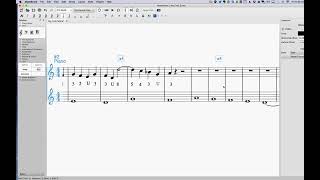
J. Anthony Allen writes a fifth-species counterpoint example from Fux's Gradus ad Parnassum, labeling intervals and explaining why 5-3 suspensions don't exist in free counterpoint. He points out deliberate rule-breaks like dissonance on downbeats and voice crossing, noting which would fail in a classroom.
Chapters
Okay, here we have a fairly famous counterpoint. I've written out the first half of the counterpoint, and I'm going to write the second half in as we go. And the cantus firmus I've written all in. This is from the book Gratis ad Parnassum. Sorry, my Latin pronunciation is terrible. By Fuchs, who we're gonna talk more about in just a second. I'm gonna give you a little history of him. But this is like. Like he literally wrote the book, and the book is Gratis ad Parnassum. So this is the book on counterpoint. This is where all these rules and the species stuff comes from. So this is one of his examples of fifth species counterpoint or free counterpoint. So let's analyze it. Let's look at it. So note here that we're in treble clef. So we have two treble clef lines. And we're going to hit a couple interesting things here. So D to A. And let's just label our stuff here. F to A, that is, oops, a third, And F to D. So that would be a six, F to E would be a seventh, and F to F would be a unison. That is kind of goofy, but we'll. We'll say it's allowed because he wrote it. E to G is a third, E TO F is a 2, E to E is a unison, and E to G is a third. Make those less goofy. D to F is a third, D to D is a unison, and D to D is another unison. Let's call that 8. G to d is a fifth, G to C is a fourth. Now, G to B flat is a third, a minor third, but a third nonetheless. So we're just going to kind of ignore that flat for the moment. And G to G is a unison. And then let's do the downbeat here. F to A is a third. Okay, so let's look at what we've got here. We have. So we have a 5, 3 here. So not technically a suspension, because a 53 suspension is not a thing. And it does not resolve like a suspension. It would have to resolve down at consonant suspension. It could resolve up if it was the right kind, but it's not. So it's not a suspension. It's just a tied note. And that's okay in fifth species counterpoint and free counterpoint, because we would treat it just as a note with a duration of three beats. Right? So now we have third, sixth, seven, and eight. Now, this bar is really interesting because we have Consonant, consonant. Dissonant consonant. So we've got a dissonant right on the halfway point, which, according to Fuchs in Fifth Species, counterpoint can be allowed in a scale pattern. So all kinds of weird little exceptions here. I would consider that to be dangerous. So I wouldn't do that if you were writing an assignment for a teacher. But, you know, he wrote the book, he's allowed to do it. So now we have 3, 2 unison, 3. So dissonance on beat 2, that's allowed. Over here. 3Unison Octave, all consonants actually. Big consonant skip here. And then another suspension looking thing, but not technically a suspension. Even though it resolves down. We wouldn't call it a 5, 4 suspension. That's not really a thing. Or 8, 5 suspension. That's not a thing either. So the contus firmness hasn't set us up to do a suspension, at least not with those notes. So a dissonance here on the second beat. And that's it. Okay, now let's keep going. So what he does next is we're going to go up to a B and then a C. And then he's going to tie that C over. And now he's going to do an F and tie that over. I'm gonna go backwards and get those ties in a second. And we have some eighth notes popping. Okay, oops. Let's go back and add all those ties that I skipped over C, F, E, D and D. Okay, now let's look at what we've got here. So we have a third F to A. On beat two we have a fourth and beat three we have a fifth. Okay, now tied over from A to C we have a third. And then we have. A to F is a six. And now we have B. Sorry, G. I'm mixing up my clefs again. G to F, which is a seven and then down to a six. And a five on that eighth note. And then back to a six. And then down to F in E. A seventh. Wow, man, this one is weird. F in A is a third, F and D is a sixth. G to D is a fifth. And then here we have our leading tone heading out. Because we're in a minor key. We're actually in A mode or in Dorian here. But G to C is a fourth, we're going to call that. And then to an octave. Okay, so let's look at what we've got here. So I think this is where we left off. 3, 4, 5. So dissonance here, that's okay. 3, 6, both consonants is to a seven resolving down. Not a suspension, though, because it goes from a consonance to a dissonance. Suspension would have to be the opposite. Seven. Six could work. Six, five, six. We could call this a neighbor tone. Even though it's a consonant. These are all consonants. We could call it a neighbor tone here to a seven on a downbeat through a sustain. Wow, that's really surprising that he's going to allow that, but he does. Interesting. I wouldn't do that if I was you. In your counterpoint examples to a 3 to a 6. Consonance Consonants. Dissonance here. But this one is clearly allowed because we're raising our leading tone to get us back to tonic there. So that one is okay for sure. So he breaks a lot of rules here. You know what's another big rule that he breaks is voice crossing. Check it out. Right here. F. That's right there. Those two notes are the same note. So right here, this note and this note, this D and E are underneath the. That. That is a voice crossing. Here's a unison. So that's not. That's not. I thought I saw another one in here. Nope, that's it. But, yeah, big voice crossing right there. That would not be allowed by a lot of teachers rules. Different teachers have different amounts that they prescribe to exactly how he wrote. You know, some of these accents. Accented notes with dissonances. I would mark incorrect on a paper, but he's going pretty far with it. But that's the interesting thing about the guy that wrote the book. Let's hear it and see what we think. Interesting. You know, it sounds very Bach. So, you know, clearly, you know, Bach knew this stuff, obviously, like nothing else. Okay, let's jump to another video, and I want to tell you a little bit more about this guy.