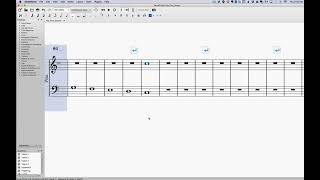
J. Anthony Allen teaches the rules for opening, closing, and penultimate measures in Second Species counterpoint. Openings use unison or octave (fifths if the cantus firmus is in the bass), the final bar must be whole-note unison or octave, and the penultimate measure can break the two half-note pattern with a leading tone rising to the tonic. Only these three bars can deviate from the standard rhythm.
Chapters
Okay, let's now work on writing some of our own Second Species counterpoint pieces. Now, just like we did with First Species Counterpoint, let's focus on the opening and closing things first, because they have kind of their own rules that we pay attention to. So the opening the first bar. Now we still have the rule. We need to open on a unison or an octave. Or we can open on a perfect fifth, as long as the cantus firmus is in the bass. So we could open on a fifth in this case. But let's keep it simple. Let's open on a unison or an octave. Now we have the rhythm to worry about here. We could open right on the downbeat. So that would be an octave, right? And that would be. Okay, so far. I need to do a different note here. But remember, we can also open on the second half of the beat like that. And here's what's interesting. Depending on what textbook you read, this is actually often called the preferred way to open a second species counterpoint. And the reason is, is that it helps clarify the independence of the two lines. You hear this one start, and then you hear this one start, and it's easier for the listener to hear that there's separate lines this way. So this is often kind of the preferred way for it to start. Interestingly enough, it seems like, you know, kind of a cheat to do it that way, but it's not. It's actually kind of good. So now let's jump to the end. Okay, so in the end, we want our last bar again to be a unison or an octave. And the rhythm of the very last bar is always going to be a whole note. So let's do. Let's go back here. So we've got an octave, actually, two octaves, but remember, we just call it an octave in this case. And we don't need another half note here. In fact, we do not want another half note there. This is the resolution. That is the end. This is the downbeat of the last bar. There is no more. Now, the bar before this, the bar leading into the end, has some special rules as well. This bar can be just a whole note if we want. Now, no other bar is going to be that. All bars need to be two half notes, right? The second to the last bar, the penultimate measure, as we call it, can be a whole note in some cases. For example, in this case, because we have a B down here, I could see it working to do a B up here. So we have a D down here, a B up here. This D To B is a sixth. We like sixth. We also like that this interval opens out in contrary motion to the octave, right? So this is a leading tone up into our octave. This is the two, and goes down to the octave. That's a really nice sound. So if we can make this make sense to land on this B right here, we don't need another note right there and the second half of the measure, that's just one kind of goofy exception. Now if where we're coming from, it doesn't make sense to get to this B and it makes sense to be somewhere else, like here, here, then we might want to do that, right? And that gets us to our leading tone. It opens out and it still gives us our nice contrary motion. So it kind of depends on what comes before and how we land here, right? So let's assume that we're going to have this A here and let's work with that for now. If, when we get there, we realize that we could land right on a B here, we might change it so that we just do one whole note. Now, other things to remember about the second. Really want a leading tone in here. So a half step below tonic is our leading tone. If you're in A minor key, you want to raise that sucker. If we were in C minor, for example, we're in C major now. But if we were in C minor, this would be A B flat and this would be an A flat. So what we would do is we would raise those both to A natural and B natural. So we would kind of invoke the harmonic minor for these last two notes to just push us into tonic a little stronger. So in the second to last measure, we would raise those in a minor key. In A major key, we just leave them just as they are. So keep that in mind. We always want to raise our leading tone and our sixth when we're at the end of a counterpoint to help just push us back into the tonic when we're in a minor key. Okay, so those are our main things to remember about the beginning and the end. Let's do a quick review. Remember the beginning. We want an octave or a unison most of the time. In some exceptions, or in some cases, we can do a perfect fifth. We can start this on the downbeat or on the offbeat. And doing it on the offbeat is sometimes preferred. The end note is always a whole note, and it's got to be an octave or a unison. The penultimate bar. The second to last bar could be a whole note or two half notes, depending on what works best and needs to be a leading tone pushing into our tonic. And if it's minor, it should be raised to use the harmonic minor. Okay, so that gets us our three goofy bars. One last thing to point out is that these three bars are the only three bars in Second Species Counterpoint that can be anything other than two half notes. All of these bars have to have two half notes in them, right? And this one could have two half notes. And this one could have two half notes. But it doesn't have to. And this one doesn't have to. But all the rest of these bars do. So those three bars are the only exceptions. Everything else has to be two half notes.