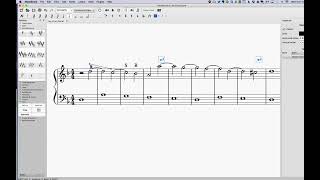
J. Anthony Allen breaks down suspensions in counterpoint: a consonant note held over the bar line that becomes dissonant and resolves stepwise down. The three parts are preparation, suspension, and resolution. The most common types are 4-3, 7-6, and 9-8, and they create the characteristic downhill motion of four-species counterpoint.
Chapters
Okay, I'm going to read you the technical definition of a suspension right now. A suspension is a rhythmic embellishment created when a consonant interval is held over the first beat of the next measure, forming a harmonic dissonance until the suspended voice moves down by step to the next pitch. Okay, so let's pick that apart. Suspension is a rhythmic embellishment created when a consonant interval. So let's look at this one from here to here, from A to C. Okay, that's a consonant interval is held over to the first beat of the next measure right there. So that's held over to the first beat of the next measure, forming a harmonic dissonance. So the result of holding this over the bar line onto the beat of the next measure is a dissonance G to C. That's a fourth, which is a dissonance until the suspended voice moves down by step to the next pitch. So it has to move down by a step to the next note, and that has to be the resolution. So this is called the resolution here. Okay. Suspensions consist of three parts. So the first part of a suspension needs to be a consonant harmonic interval. And we call that the preparation. So let's. Let's get our text out here. So we're going to call this. Let's do a P for preparation. That's going to be right here. So it's going to be on the second half of the measure because. And that is our consonant interval. The preparation is consonant. Our second thing is the suspension. That's right here. The actual suspension is when our note that was our preparation has now become dissonant. That makes the suspension, suspension. And then the third part is the resolution. And that is going to be this note. Psr. Preparation, suspension, resolution. Okay, now in this case. Well, let's look at a different example. Let's look at over here. Preparation, suspension, resolution. We can and often do chain these together like what I did here. Right. There's kind of a chain of two. In this case, this one is the resolution and also the preparation. In fact, let's do that a little bit different here. Let's make that a little clearer. This one is the resolution. It's also the preparation for the next one. Preparation, suspension, resolution. So this one can serve double duty when you're doing these chains of suspensions. Now, there are several types of suspension, and we label them with numbers. There's 4, 3 suspension, 7, 6 suspension, and 9.8 suspension are the most common. We're going to talk about those in a minute. But first, I want to talk about one of the kind of main characteristics that doing this results in. When we're doing four species counterpoint, we tend to have this kind of falling downhill thing. Because suspensions always resolve down, you can't do them opposite. So we have this kind of going downhill mentality. So let's jump to a new video and talk about this going downhill issue.