In this tutorial J. Anthony Allen walks viewers through a practical, step‑by‑step approach to selecting studio monitors. He stresses that the most reliable way to choose monitors is to listen to them in person, either in a music store or a studio, using a familiar, clean reference track – he recommends the Art of Noise album Seduction of Claude Debussy because it is well‑produced and he knows it intimately. Listeners should look for an even, flat frequency balance with no single range (e.g., mids) overly pronounced, and they should test the speakers at higher volumes to ensure they do not distort. Allen advises buying active (powered) monitors, which contain built‑in amplifiers, to avoid the complexity of matching separate amps. He stresses the importance of purchasing a matched pair of the same model for accurate stereo imaging. He then reviews a range of popular monitor options and price points, from budget‑friendly JBL 305 MkII and KRK Rokit (≈$179 each) to mid‑range Yamaha HS8 (≈$350 each) and entry‑level Genelec (≈$300 each), up to high‑end Genelec 8030s (≈$700 each). He mentions using Sweetwater.com for price research and notes his own past use of Blue Sky monitors. The overall message is to combine informed listening tests with realistic budgeting, focusing on flat response, low distortion, active design, and matched pairs.
Chapters
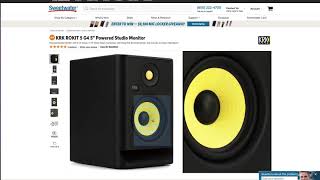
Okay, let's talk about studio monitors. Now in this. In this video, I'm just gonna give you some straight up. Here's what I like. But the. The key to selecting studio monitors is two things. One, listen to them. These are really hard to buy online. You really kind of need to go to a store and listen to whatever you can. Another thing you can do is go to studios and listen to what they're using. Just listen to as many as you can. And crucial to that is pick a piece of music that you know really, really well and listen to that on the as many different monitors as you can. I use. There's this one album that I always use to test speakers. It's the Art of Noise, the Seduction of Claude Debussy. Let me show you. Art of Noise, Seduction, Claude Debussy, this album. I think I've talked about this album before in this class. Now, the reason I use this album is because A, I really love the music. B, it's recorded and it's mostly electronic. It's really clean, it's really precise, it's mastered really well. And I've listened to it a million times. Like, I know this thing backwards and forwards. So I always use this album to test speakers. You can use whatever you want, but just use something that's really clean. You can. It's not something that's really distorted. Will be hard. So, like big rock stuff will be kind of hard to hear all of the frequencies. Although if you know it really well, it might be okay. I really like this album for that mostly just because I know it really well. So I always listen to that album when I'm testing out speakers. So listen to them and find something that. That really speaks to you. And what we're looking for is an even frequency balance. So you want to be sure that no frequencies are popping out. It's not like you. You hear some tone coming out when. When the music hits some frequency and you're like, wow, there's this one sound that's just really popping out. That's not what you want. You want it to be really flat so no frequencies are jumping out at you as out of place. You want to make sure the volume stays at about the same level all the way across. So if you're listening and you hear and you think, wow, the mids are really loud in this mix. And I've never heard in this music the mids be so loud before. Then you know that that might not be the right speaker for monitoring because you don't want something that's going to accentuate the mids like that. And then the third thing is make sure it doesn't distort. Give it some good volume, crank it up and make sure that you don't get distortion out of it. Cranking up the volume when you're mixing can actually be useful. You don't want to mix everything really loud, but there are times when just turning everything up really loud can be kind of useful. So you want to make sure that it doesn't distort when it gets loud. And cheap speakers will do that. So I pulled up here a couple things to look at. I always just like to go to Sweetwater when I'm just kind of looking at prices and stuff. Sweetwater.com is a retailer in the US so if you go to shop by category studio and recording, go down to studio monitors and then we're going to go to active monitors. Now an active monitor means that it's got an amplifier in the speaker. Let me just show you. I pulled up a couple here. So here's a jbl. If I look at the back right, I can just plug this one into the wall and then I can plug my input into it. I don't need a separate amplifier. You really don't want to deal with a separate amplifier. This will save you money and also save you having to figure out the best amplifier for the best speaker. When you're dealing with studio monitors, I highly, highly, highly recommend go with an active monitor. You'll have to plug these right into the wall and you'll know if it's an active monitor because you have to plug it into the wall. It needs power. If it's not an active monitor, it won't need power, it'll need an amp. So active monitors is really what you want to look at. Or powered monitor is the same thing. Okay. So popular ones are the JBL series. So JBL is the company. They have a lot of different ones. 305 mark 2. This is kind of a random one I grabbed. These are popular. These KRK rockets I see being really popular lately. We use these at Slam Academy. They sound really good. I really like them. And they're relatively cheap. What is the price on these? 179 each. So remember, when you look at the prices of these, you need two of them and it is absolutely critical that you get the same speaker. Right. You can't have two different brands of speakers on the two different sides. You need matched pair. So one 79 each. So roughly 350 bucks. A little more than that for a pair of these, that's reasonably good. Studio monitors are expensive, right? So 179 each is a good price. And these are nice sounding, relatively inexpensive. You can get some much more expensive ones. Here's the Yamaha HSA8. This is a popular one that I see being used a lot. If we flip it over, we can see that it's an active, it's powered speaker. Those are popular. A bit more expensive, right? $3.50 each, right? So that means 6, 700 bucks for the pair. And then we get into the really high end ones, the Genelecs. These sound really great, but they're expensive. So 300 bucks. And this is a low end Genelec. This is a relatively inexpensive Genelec. This is a powered speaker. I think the plug must be on the bottom, it must be down here at the bottom. But it is powered, so it is an active speaker. Here's a higher end Genelec. These are 700 bucks a piece. The Genelec 8030s. These are nice, they sound really good. But they're really expensive, so you don't need these. You can do just fine with, you know, these JBLs or something like that. As long as you hear them and they sound good and you like the way they sound. So the best way is go into your local music store if they have some studio monitors set up, listen to some stuff, cue up music that you know. If you're serious about buying studio monitors, the store will let you play whatever you want through them. They should know this. So try those things out now. The ones that I use, I don't think they're not made anymore, so they probably don't have them here. I use these blue sky ones which were really popular about six years ago when I bought them, but I think the company went out of business. They sound really good. I'm probably about due for new ones though, so I might upgrade to some Genelecs. But I'll show you what they look like when we get to kind of how everything is set up. Okay, so that's my advice on studio monitors. Let's move on.