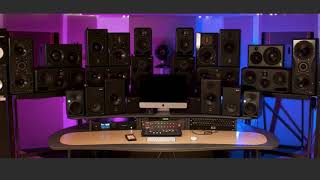
J. Anthony Allen explains why room acoustics and accurate studio monitors matter more than headphones for mixing. Poor acoustics and colored speakers give false frequency information, making mixes sound weak or unbalanced elsewhere. Honest mixing requires flat speakers and a treated room that doesn't add or subtract bass or high frequencies.
Chapters
Okay, let's talk about your listening environment. Now, this is the room that you're in, probably the room that you're in right now, but the room that you're going to be doing your mixing in. So why do we need to focus on this? Can't we just use headphones and then the room doesn't matter? Yeah, kind of. Headphones are good, and we'll talk about headphones in a minute. But the listening environment does matter because you don't want to always use headphones. So if you can, you want to get a set of studio monitors, and we're going to talk about what I look for in monitors and how to set them up. I'll show you the kind that I have, and I'll show you how my room is set up. But there are other things to consider as well. It's not just about how fancy your speakers are, right? It's about the design of your room matters. The acoustics matters. Now, I'm not an acoustician, so I can't go into all of the math around the perfectly acoustically treated room, but we're going to go over some general things that's going to make your room sound as good as possible. And why. Why do we care about this? The answer is honesty, right? Honesty is a weird word to use, but I'm gonna stick with it. So by honesty, what I mean is that we need to make sure that our mix sounds real. It sounds honest. It sounds how the music actually sounds, right? So we need good speakers, we need good acoustics. We need to make sure that we're accurately hearing what. What the computer is doing, right? Because if we have crummy speakers and they're adding a whole bunch of bass, then that means that our mix is probably lacking in bass, because we're going to mix the bass low, because our speakers are adding all kinds of bass, right? So we need to make sure that we don't do that. We need what we call flat speakers, but speakers that are very honest. Now, similarly, if we're mixing in a room and it's got a higher frequency ring around, I don't know, 4,000 hertz or so, then we're probably going to pull down 4,000 hertz in our mix. So when someone else takes it and listens to it, they're going to say, there's really just something missing on the high end here, because we've pulled it down. Because our room was not honest, right? It was giving us false information. So that's why the listening environment is crucially important, because if it's giving you false information, then it's. You're going to screw up your mix. Okay? So that's why we care. Now, let's go into things we should consider in our listening environment. We'll start with some acoustics.