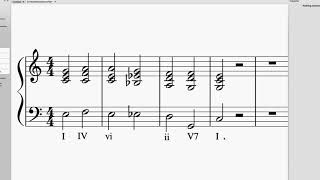
J. Anthony Allen plays a chord progression in C major and identifies an unexpected E♭ major chord functioning as a borrowed flat-III. He walks through harmonic analysis step by step, showing how accidentals signal out-of-key chords and how to notate borrowed chords with a flat sign before the Roman numeral.
Chapters
Okay, let's talk about mode mixture. So I have a chord progression here for us. And rather than just give you a textbook definition of mode mixture right away, I thought, let's hear it. So let's listen to this funny little chord progression and see if we can figure out what's going on. Here we go. Okay, so what do we have here? We have a chord progression. Starts in C major, C, E, G, with an E in the bass. So we can call that C major, ends in C major. C, E, G, C. It's got a big G7 before it, so probably V7 to I. So pretty safe to call this whole chord progression in C major. Let's hear it one more time. Something weird happens right in here, right? There's something not right. And we can kind of see there's all these accidentals right here. So this chord is throwing a curveball in there. So we have to explain that. Okay? So this can easily be explained with mode mixture. This is not in the key. This is not in C major. We know it's not in C major because we see these accidentals, right? The accidentals. Before we even read what notes they are, we can say this is out of key because there are accidentals. The sheer fact that the accidentals are there tells us that it's out of key. So. Let's take a quick look. Let's analyze. Some chords. Okay, so let's call this one six. Actually, I'm going to leave off inversions for the moment. So this is a C. So this is one fac F. This is clearly A four. Oops. Four. Okay, C, E, A, A, C, E. That's clearly A six. Nothing strange there. Minor six, all in key. Nothing weird. Now this super weird. Let's skip it for the moment. Let's go to here. D, F, A. So that's a two chord in the key of C. D minor. And then here we have a g with a seventh in it. V7 and I. Okay, now let's go back here. First, let's figure out what the root of this chord is. Have an E flat, a G, and a B flat. So if I move this B flat up an octave. Okay, now I can see. Oh, I just made a triad. So that means the root of this must be E flat, because I can make a triad. Let's put it back to where it was. Okay, we have an E flat in the base too. So this is clearly an E flat chord. The root is E flat. Okay, that's not in the key. How can we build a chord On a note not in key. Well, it's very easy. So let's say this is some kind of three chord, right? Because E flat is. If it was an E natural, we would call it a III chord, right? Minor three. That's what's in key. But it's an E flat. So first of all, is the chord major or minor? E flat, G, B flat. That's a major chord. So it's a major three. Okay? But it's not based on E. So this Roman numeral, if we just write major three, that tells me E natural, G sharp, B natural. That's what that Roman numeral is telling us. But that's not what we have. We have E flat. So we need a symbol that's going to lower the root and that is this. We put a big old flat symbol before at the beginning of the Roman numeral that says this is a lowered three chord and it's major. Okay? So what we have here is E flat major in the key of C. So I'm going to put that flat symbol right in the Roman numeral analysis. It's not going to be a little subscript flat like flat six or something like that? No, it's big ol flat three. Meaning this is a major three chord flat. E flat major is what we've done here. Now, how can I call this an E flat major chord? How can this exist? Mode mixture, Right, So let's go a little bit deeper. Let's go to a new video and talk about what mode mixture is and how we can explain away this chord.