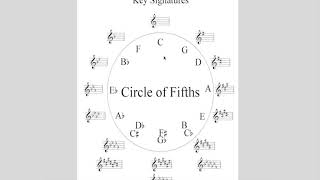
In this instructional segment, J. Anthony Allen reviews the fundamentals of the circle of fifths and its practical value for songwriters. He begins by reminding viewers how to identify a key from its signature, derive its scale, and build diatonic chords. He then introduces the circle of fifths as a visual layout of all major keys arranged by perfect fifth intervals, starting with C at the top and moving clockwise to add sharps, and counter‑clockwise to add flats. Allen explains how each step adds or removes a single accidental, creating closely related keys that differ by only one note. He discusses enharmonic equivalents (e.g., F♯/G♭) and the necessity of switching between sharp‑heavy and flat‑heavy sections of the circle. The lecture also notes that traveling left around the circle yields a circle of fourths, the inversion of a fifth. Throughout, Allen emphasizes the circle’s utility as a tool to overcome writer’s block by providing immediate, musically coherent key options for modulation, chord progressions, and melodic ideas.
Chapters
So by now we know how to find the name of the key that we're in based on the key signature. We know how to find all the notes in that scale once we know the name of it. And we know how to build some chords using it. Seven of them actually, and then actually no more than seven, because we know how to build the seven chords that are in the diatonic chord progression and then we can build seven more that our sevenths. And then I guess that's it for now. But we're going to learn how to do some more later in this class. So let's start with something relatively simple. The circle of fifths. Now you may have seen this before. This is kind of a cliche, right? Like you've, you've made. If you've been in like a music classroom before, you've seen this thing called the circle of fifths on the wall and you're like, yeah, okay, that's neat. But I want to try to convince you here of the value of this thing, particularly if you are a songwriter. I'm going to show you how to use this to get over any mental hurdle you have. In other words, writer's block. If you're stuck, if you're writing a song and you're stuck, go to the circle of fifths. It's a great place to be to give you a whole bunch of new ideas. So first let's just talk about what this thing is. Simply put, it is all of our keys laid out in a circle of fifth related keys. In other words, a circle of fifths, right? So we put C at the top and if we go to the right, it's going to be a fifth higher. So G, right? So if we count up C, D, E, F, G, that's five, so that's a fifth higher. So then we're on G. If we count up five notes, we get to D, and here's the key of D, right? We count up five notes, we get to A and this is the key of A. We get to E and that's the key of E. Counting up five notes around the circle. Now let's look at, before we go any further, let's look at some of the, the kind of interesting things that pop up when we do this. What happens is when we go to the right and we go around the circle, we always add one accidental, right? Zero accidentals, one sharp, two sharps, three sharps, four sharps. That tells us something kind of interesting about how keys are laid out. If we're in the key Of C, there are zero sharps. If we go to the key of G, there is only one sharp. That means that the key of G is kind of close to the key of C. There's only one note that's different. In C you would have an F natural, and G you would have an F sharp. So these two keys are closely related. We call them closely related keys is the actual term we use. Similarly, G and D are closely related keys. So you can go either direction in this and find a closely related key. Okay, now let's keep going. So we're on E, right? If we go up a fifth of E, we end on B, and that is the key signature for B. Now, this particular drawing of the circle of fifths is showing us C flat. Because at some point, usually at the bottom here, we've got to switch over to flats, right? So typically, the very bottom is where we do it. This one is doing it on C flat. And it's going to give us a C sharp down here, too. So what that means is. Let's jump to here for a minute. F sharp and G flat are the same, right? They're gonna have all the same notes, but they're gonna be spelled very differently. So at some point, we gotta switch over to flats to make this thing work. So this is the key signature for F sharp. This is the key signature for G flat. They're all the same notes, but they're spelled completely differently. But the way they sound will be the same. So we overlap here just so that we can kind of transition to flats going forward. And you'll see a bunch of different ways of drawing the circle of fifths. This one shows the key of C flat down here. It's kind of weird. They don't all do that. Some of them look different. That's okay. They all basically show the same thing. So let's keep going. B up a fifth gets us to F sharp or G flat, whatever. Let's go G flat to transition to flats up a fifth gets us to D flat. And there's a key signature for D flat and C sharp, if you like. D flat up a fifth is to A flat, up a fifth to E flat, up a fifth to B flat, up a fifth to F, up a fifth from F gets us back to C. So it makes a complete circle. Okay, so let's look again at how our accidentals behave when we go around in that circle. So we add A sharp, we add two sharps. Well, from here to here, we add A sharp. From C to D, we Add another sharp. So we're always adding one sharp, right? Here we're down to five sharps. F sharp, six sharps. If we stay and do C sharp, we're at seven sharps. But let's jump back and switch to G flat here. So we're at six flats, and now we're going. So now that we're in flats, we're going to lose one at every turn. So G flat to D flat, 5 flats, A flat, 4, 3, 2, 1, and then back to 0, right? So every neighbor is a closely related key. For example, if you're in the key of B flat and you want to find a closely related key, this is telling you two options. F or E flat. Both of them are only one accidental different than B flat. Right? So those are closely related keys. I'm going to talk about how that factors into songwriting and things in a minute. I want to point out one more thing here. Remember in the previous class when we talked about inversions? Right. So what's the inversion? Or in other words, what's the opposite? A fifth. It's a fourth, Right? A perfect fifth. Inverted is a perfect fourth. Which means we might call this the circle of fourths. If we start here and go to the left, C up a fourth is going to be F up a fourth is going to be B flat, up a fourth is going to be E flat. That'll work all the way around. So it's a circle of fourths if you go to the left around it, and a circle of fifths if you go to the right. Okay, Shows us all our key signatures and all our closely related keys. That is the value of the circle of fifths. And that is what it is. Now let's break to a new video, and I'm going to show you how to use this thing as more than just a wall decoration, but as something that will actually help you to create more interesting music if you are a songwriter.