J. Anthony Allen explains how tension and release in harmony are created through consonance and dissonance. He classifies intervals, noting that the minor second, tritone (augmented fourth/diminished fifth), and major seventh are the strongest dissonances, and shows how interval inversion (seconds ↔ sevenths) preserves dissonant character. He then discusses chord function, stating that the tonic (I) chord is the least dissonant while the dominant (V) chord generates primary tension because it naturally wants to resolve to I. Adding a seventh to the V chord intensifies this pull. Allen demonstrates how a measure of rest can heighten anticipation, and introduces the idea of prolonging the dominant to increase tension before resolution, setting up further discussion on techniques for extending the V chord in film scoring.
Chapters
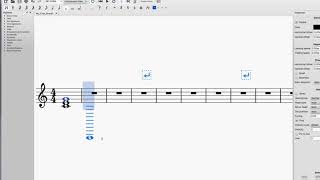
Okay. So when we talk about tension and release in terms of harmony, the more typical terms we would use would be consonance and dissonance. Right. So if you've taken my theory classes or done any theory work at all, you know a little bit about consonants and dissonance, let's look at it in a couple different ways. First, so we have certain intervals that are considered dissonant. Let's do a whole note and let's use C as a basis here. So looking up our scale, if I go up a major scale, C to D is that sound that's a major second. That's kind of a dissonance. But if I go out of the scale and go to a minor second, that is a much stronger dissonance. So a minor second is a very strong dissonance. Sounds like that. Okay, So a minor second is any two adjacent notes. So notes that are right next to each other. So that's a minor second. That's probably one of our strongest dissonances. Always when we go outside of the major scale into the more chromatic notes is where we're going to get the stronger dissonances. If we want them back in the scale, go to the third. That's not a dissonance really at all. The minor third could be considered a dissonance, but not really the fourth. C to F is actually really interesting because in some periods of time it was considered a dissonance, and in others it was considered a consonant. Really interesting. To us, it's pretty much a consonant. It sounds pretty. Okay, so let's call that a consonant. This one, however, this is our tritone. This is another very strong consonant or dissonance. So very much like the minor second, this one is very dissonant. So your two strongest dissonances are a minor second and a tritone, which is another way of saying an augmented fourth or a diminished fifth. A fourth that's one half step too big, or a fifth that's 1/2 step too small. Same thing. Let's keep going and just see what else we have here. We go up to the sixth, not a dissonance because it's an inverted third. A seventh can be considered a dissonance, but if you put some other notes in there, you make a seventh chord, which can sound really nice. So seventh is interesting, but if we invert a seventh, we end up with a second. So. And so the same rules of the second apply. A major second is sort of dissonant, but a minor second is very dissonant. So if we Invert that. That means that a major seventh is as dissonant as a minor second. If that's confusing, review the rules on inversion from the theory stuff. So a minor seventh, which is what we have here, inverts to a major second. So it's a little dissonant, but not a ton. It's kind of dissonant. If we go to a major seventh that inverts to a minor second. So that's fairly dissonant. So let's call our strongest dissonances three a minor second, a tritone and a major seventh. Now let's look at our chords. So I don't want to go through the whole diatonic chord progression system here. We've done that in other classes, so. So review that if you need help on figuring out what chords will go in what key. But remember that a chord built on tonic. Let's do it here. Okay, so a C major chord, a I chord, chord built on tonic, all the same thing. That's going to be our least dissonant chord in any key. If we're in the key of C major, it's going to be C. If we're in the key of D major, it's going to be D, et cetera. That's going to be our least dissonant chord. It's hard to say what our most dissonant chord is because I could say, well, any combination of dissonant notes is going to be our most dissonant chord. So let's talk about our most dissonance, tension making chord. That's probably going to be our V chord. If I'm just using major and minor chords, because our V chord always wants to lead to the I chord. It has that tendency. Right. So that V chord is going to be our best way to create this kind of tension because it has somewhere it wants to go. And the longer we stay there, the longer we're preventing it from going where it feels like it needs to go, which is what makes tension. So this five chord by itself is not dissonant, but it has a feeling of wanting to go back to I. And now you kind of want to hear that again. We can make it even stronger by adding a seventh to it. That even more so feels like it should go back to one. So this will feel good, this will feel consonant. This will feel like we've stepped away and it's something farther away and there's a little bit of tension in that. And then we go back to this, which is what we want to do. Okay, now what if I did this, what if I put a measure of rest in here? During this measure of rest, we are going to feel like we are going to be waiting for this chord. That's going to be a silence of tension. Because we're going to want this chord to happen and we're going to be waiting for it here. So hear me out. So during that rest, you were like, where's that chord? That is tension and that is release. So what I want to do in this section is look at a couple different ways we're playing with the 1 and the 5 chord to create this kind of tension and release. We know how to work with chord progressions already. So what I want to do is talk about a couple different treatments for this dominant tonic relationship. That's what we would call this. This. This is tonic. This is dominant. So dominant tonic relationship. A couple different ways we can look at that to create even more tension than just having a tension filled chord progression. Okay, so let's move on to another video and we're going to talk about prolonging the five for a while.