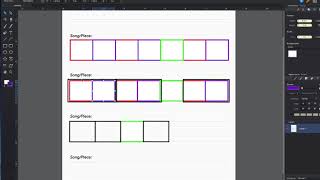
In this instructional lecture, J. Anthony Allen explains how composers can think about musical form on two hierarchical levels to shape tension and release. He uses color‑coded boxes to represent sections (A, B, C) and shows how individual sections (e.g., verse, chorus, bridge) contrast with each other. By grouping paired sections (red‑blue) into a single higher‑level unit (the black box), he demonstrates that repeated units increase tension, making an odd or contrasting section (the green box) a stronger release. Allen emphasizes that the more a unit is repeated, the greater the eventual release, and notes that harmonic choices can further shape this effect, which he will discuss later. The talk is aimed at composers and film scorers seeking concrete visual tools for structuring music.
Chapters
Okay, so when it comes to form and tension and release, I want to talk about form, kind of two different levels. I'm going to use these boxes to represent the different sections of a piece of music. So let's call the red box an A section. So I'm just going to assemble a piece down here. So. So for each section, what we're thinking about is like. Like if this was a pop song, we would think about a section or one of these blocks being a verse, another one being a chorus, another one being a bridge. If this was a more classical style of piece, we would call each section. It might be the A section, the B section, the C section. Different melodies might be in their own section. Different chord progressions. You can kind of do it, however works best. But the main thing is that if you imagine this block is a piece of music and this block is a piece of music, they somehow contrast each other. So this happens and then this happens and they are contrasting. Okay, so here's what I mean by the different levels. So let's say our red section happens and then we're going to do our blue section and then let's say we going to do our red section again and then maybe our blue section again and then our green section for something different and then red section again and blue section. Okay, That's a perfectly normal piece. The this was a pop song. It would make pretty good sense. Verse, chorus, verse, chorus, bridge, verse, chorus. Okay, pretty fine. So the tension and release aspect here is between each section, every time the color changes, we have a contrast that makes a somewhat of a release. We want this to feel like it goes to this, and we want this to feel like it goes comfortably into this and this. And the red goes into the blue, the blue goes into the green, the green goes into the red, and the red goes into the blue. Right. Easier said than done. But that's the way we want it to feel. So that it feels like it's always progressing along. Let's get rid of that floating green guy up there. Now that's one level, but let's look at that in a slightly different way. So I'm going to copy this whole thing. And let's take that down here. Okay, so I've just duplicated again into a new piece. So same deal. Remember, everything is its own section. And we've got this first chorus, first chorus, bridge, verse, chorus thing. Okay, but now let's look at it a little bit differently. I'm going to make a new block and let's color this one Something that stands out. It's hard to do with those colors I've chosen. Maybe just black. Okay, let's just use black. So what we're going to do is we're going to take one step back from all of this. And instead of looking at each block as their own thing, we're going to group some things together. Okay, so what I'm trying to represent here is that this black box is an A section and a B section. So I've got one step backwards. So now what I have is a repeat of the AB section or the black box. Something different here and then this. So in other words, do that from scratch down here. Let's just make these a normal box. In other words, I have that. Okay, so let me walk through that one more time. That might have been confusing. So red box and blue box, verse and chorus. Right. Those are always paired together. So let's now take a step back and think of it as just one thing. Since red and blue are always paired together, we're going to think of that as one unit. So that is an A section. Let's call it the two of them together. That still makes this green box the odd box. But when I think about it like this now. So I have this. This. Something different than this now. My tension element is more. Because I have this repeating. We've been hearing this a bunch, and then this becomes more impactful. So I would think about that while I'm writing. I would think about how can these two pieces together make this more of a release when we get there. Right. And there are musical elements that we could do to do that. And we're going to talk about those more when we talk about harmony. That's the main way I would do it. But let's do one more using the same idea with the black box. Oops. Didn't copy everything. Okay, now, what we know here from this little experiment is that when sections repeat, it adds to the tension. So this is going to be more intense than it would be if there was only one of these. So by that same logic, I can make this odd piece, this odd section of the music feel even stronger. If I want this to be even a bigger release when we get there, what I can do is this. Okay, what do we have now? We have this A section, which is really two sections inside of it. But the A section that we're calling it the black box. Let's call it the black Box. Black box four times. That just keeps going and going and going. And then finally we get something different. That's going to be a very satisfying release. That doesn't mean you should always repeat everything four times. But the more you repeat it, the stronger this release is gonna be. Right? So keep that in mind. So this is kind of the two levels of stuff. We can look at things as individual sections, but we can also step one level back and look and, like, pair sections together and look at them as one kind of big section. And then our kind of odd pieces stand out a little more. So keep that in mind as we move forward, especially this idea of repetition to build up more tension and then make a bigger release.