Music Theory Comprehensive: Basic Ryhtmic Elements
J. Anthony Allen teaches rhythmic notation basics: flags, beams, and dots, plus note values from whole notes to 32nd notes. He demonstrates counting patterns like "1 e & a" for sixteenths and shows how to mix note values so they add up to four beats per measure.
Chapters
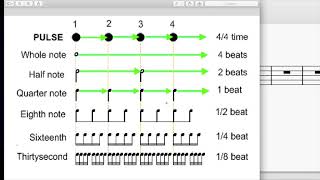
Okay, let's talk about how we notate rhythms. So remember again, the word notate. What I'm saying here is this is really how we write down and read rhythms. Our symbols for rhythms consist of kind of three elements and kind of only two elements, in a way. So let me show you some. So all of these symbols up here, all of these things are different rhythms. Okay, so let me just put some notes down here. Let's make a bunch of Cs. Okay, here's two Cs. Let's do this and let's do that. Then I just want, like, a good assortment of things here so I can kind of explain how they work. Do that. And then let's do something a little faster. Okay, this is good. Shows us kind of everything I need to see. So those three elements, we have a flag, a beam, and a dot. Okay, so this is a flag, this is a beam. This is another beam, and this is a dot, right? Dot looks like a dot. So here's what those mean. Each one of those has a different rhythmic value. Now, the reason that I said there are kind of these three elements, and in a way only two, and that is because the flag and the beam can mean the same thing. For example, let me go over here to a new bar here. I'm gonna make one of these, and it has a flag, right? If I make two of these in a row, those flags kind of reach out and shake hands and turn into a beam. Okay. So they still mean the same thing. It's just that when there are two of them in a row, we beam them together. And when there's just one, we. And when there's three in a row and four in a row, we beam them. But when there's just one like this, it's just a flag. So flags and beams tend to mean the same thing. So dots. When there's a dot on a note, it means it gets a little longer duration than it normally would if it didn't have the dot. So this gets some amount of time. This gets a little more amount of time because there's a dot on it. Okay. And then the more beams it has. So this has one beam, this has two beams, right? The more beams it has, the faster it goes. Here's something with three beams. So here's three beams, right? So that's going to go really fast. So the more beams it has, the faster it goes. Now let me look at. Let's look at it. I have a couple little graphics here. Let's look at this one. This is a little graphic I found just online. It's not very high res, but I think you can see what's happening here. Okay, so let's say this is the pulse of our piece of music. Okay? So our pulse is one, duh, duh, duh,duh. Okay? That's the pulse. We're in a duple meter. So we hear this 1, 2, 3, 4, 1, 2, 3, 4 kind of pulse. Okay? So for every four of those pulses, we could have this whole note. A whole note looks like this. It's got nothing on it. It's empty. It's not filled in the note head the way those ones are. So these are filled in. This one is not filled in the inside of it. And it has no flag or beam or dot. This is called a whole note. It takes up four beats. So four of those pulses is going to be one whole note. So now remember this as you go forward, we're going to start talking about fractions a little bit. So whole, whole note, W, H, O, L, E. It is the whole bar. In this case, it's the whole bar. Let me go back to my. Here we go. If we want to cut that in half, we end up with what are called half notes. We get two of those per bar, okay? So two half notes can fit in one bar. Or another way to say that is a whole note is the same amount of time as two half notes. Yet another way to say that is each half note gets two beats. So let's look at that here. Here's a half note. Let's go out here. So I'm only going to be able to put two of these in this bar. If I try to put a third one, it's not going to let me do it. See, because two of those fit in a bar, right? If I try to put one over here, it's not going to let me do it because it says you have a rhythmic value taking up the entire bar. You can't add a half note into this bar because this one whole note takes up the whole bar. Because each bar here gets four beats. And we'll talk about that more in just a second. But for now, just remember, each one of these bars, which is a grouping of stuff between these two vertical lines, right? Now it gets four beats, okay? And a whole note equals four beats. So we can only have one of those in a bar. These equal two beats. So we can put two of those in a bar. If we look at the next thing, a quarter note equals one beat. So we can have four of those in a bar. Now, another way to think of that is that when it comes to that pulse you're feeling in any song, you probably are feeling a quarter note. Each one of those gets one beat. So we can do. We can put four of these in a bar. Okay. So let's mix and match those just a little bit and let's hear what it sounds like. So if I did a half note and then two quarter notes, what does that rhythm sound like? Well, if this is our beat. Let me do something you can hear. I'm gonna clap. I'm gonna clap the beat. The main. The main pulse, which coincidentally is also going to be a quarter note. So this is my quarter note. Okay. And I'm going to very sadly sing, not sadly because it's a sad rhythm, but sadly because I'm a sad singer. Sing this one bar that we're looking at here. So here we go. That was it. Right, because we have half, quarter, quarter. Right, let me just do this one bar over and over. So half, quarter, quarter, half, quarter, quarter, half, quarter, quarter. So you see how that works? This gets two pulses. This first note, because it's a half note, this gets one pulse. Okay, let's do another one. Let's do a quarter note and then a half note and then a quarter note. Okay, so just looking at this one bar. So this bar is going to be. I'm going to say quart for quarter because I need to say something with one syllable. So I'm going to say quartz and whole for or half. So quart for a quarter note and half for half note. Here's my beat. Court. Hwa. Quart. Right, so this one's going to be quart, half court. Let me do it a couple times, just in a row. Just loop that one bar so you can see how it works. Quart, half court, court. Half court. Court. Half court. Quart, half court. So you can hear me holding this note on beat three, which happens here. Right. Let's look at the other ones. We can go down even farther. We can keep splitting these notes, which is basically what we do as we go down. So we split our. We took our whole note, we split it in half, we got half notes, Split that in half, we get quarter notes. What happens when we split a quarter note in half? We get eighth notes. That's where we start to get the beam and the flag. If one is just by itself. So each one of these get a half of a beat. Okay. So those look like this. These are half note er. So let's look at how just that measure sounds. How this is going to sound is there's going to be one of them for every beat, plus one of them in between each beat. So if this is my tempo, it's going to be. So every time I clap, there's one there, and then in between the claps, there's one there too. Because the beat is here, here, here, and here. If we just had quarter notes here, that's where they would be. But we have eighth notes, so there can be one in between. Right? Let's do some combinations of quarter notes and eighth notes. Quarter note, eighth note, quarter note, quarter note. How about that? So let's look at just that bar. So this is going to be. So this gets a whole beat. This is an eighth note. So this is the downbeat, this is the beat, and then this is the eighth note in between. So we have two of them. So it's da, da, da, da. Now, at this point, it would be important to introduce counting, because when we do these kinds of things, what we ought to be doing is counting. And how we count is we count one, we count one, two, three, four for the beats. And then we've got funny little syllables we say for things that happen in between. So we would count here, we would count one, here we would say two, because this is the second beat. Then here we would say the word and. And then 3, 4. So we would count this as 1, 2 and 3, 4, 1, 2 and 3, 4%, 1, 2 and 3, 4,. Etc. This one, this changed since I last did it because I accidentally hit this note. But let's check it out. How we would count this one is 1 and 2 and 3 and 4, 1 and 2 and 3 and 4. Right? There's no four. And that would be right here. And it doesn't happen because that's quarter note. So from here on out, let's try counting instead. But let's look at a couple more divisions of the beat. We have one more that's common, and then 30 second notes get kind of uncommon. But if we split the 8th note, we get 16th notes, they get a quarter of a beat, so they have two beams. So Here are some 16th notes. Okay, so these, the syllables we use for these just kind of the nomenclature is one. And then this is going to be two, because remember, there's four of these for every beat. Now, so this is going to be one E. And so E and is how we say that. This is just the way people have been doing this for centuries. They say E And a. It's kind of goofy, but it works. One of the reasons that it works is that over here, this, in this case, this is going to be two. Because this is beat two, two and three. Right? If you overlaid that right here, because this is beat 2, 2 and. And then beat 3 would be right here. So the. And we would still say. And. Except we have A, E and surrounding it. So 1e and 2e and. Okay, let's combine some other stuff in here. So let's do this. Let's combine three different rhythms. Okay? Now, one thing that's important is that when you're making these rhythms, it all has to add up to four beats for us, because we're in this four, four time. We're going to talk more about that in a minute. But for now, just remember there's only four beats in a measure. So these four notes add up to one beat. These four notes add up to one beat, so that's two beats. These 2/8 notes add up to one beat, SO that's three. And this 1/4 note adds up to one beat, SO that'S four. So this all equals out to four beats. The way that's going to sound. I'm going to count it and clap. So here's my beat. Let me slow down just a little bit. Okay, Here we go. 1e and a, 2e and a, 3 and 4. 1e and a, 2 e and a, 3 and 4. One e and a, 2e and a, 3 and 4. One e and A, 2e and a, 3and 4. So what I'm doing here is 1e and a, 2e a, 3 and 4. Remember what I said, that the more beams they have, the faster they go. And that's how rhythms work. Now we could divide 16th notes into 32nd notes. We need eight of those to make one beat. Make one quarter note, right? That's really fast. And you can go farther. Okay, so those are the basic elements of music. Now, we haven't talked about dots yet. Let's break to a new video and talk about dots. There.










