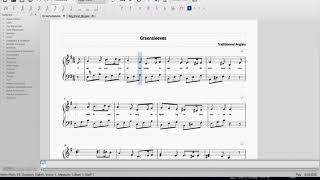
J. Anthony Allen explains compound meters using "Greensleeves" and clapping exercises. In 6/8 time, six eighth notes group into two beats of three notes each. The key insight: listeners can validly feel either the faster eighth-note pulse or the slower dotted-quarter pulse.
Chapters
So not always when we talk about music theory are we focused on pitches. We think about pitch for the most part when we're talking about music theory, and we think about analyzing chords and harmonies and finding what notes work together. But a very large part of music theory is also understanding rhythms and reading more complex rhythms. So I want to take a section here and go back to rhythms. We talked a bit about rhythms in the first class. We definitely did. I don't think we did in the second class because we were mostly focusing on the major scale. But here in this class, I want to just do this next section on rhythms and particularly compound meters and how we notate those and how we read those and how we play those. So let's start by just playing something. So I want you to listen to this piece. You've probably heard this before. This is Greensleeves. It also has five other names. And let's just listen to it, and then I'm going to talk about it a little bit, Sam. Okay, so let's do this. Let's play this song again. But this time I'll just play, like, the first line or so. And what I want you to do is. Is clap along. So just clap or tap or hit something or, you know, do some kind of. Make some kind of sound. Surprise me. I won't be able to hear it. So do whatever you want, but make some kind of sound and do it on the beat. Okay? So I'm just gonna play this first line again and decide what you think is the beat and clap along. Okay, Here we go. Okay, so I'm guessing that you probably picked one of two things. Probably most of you are clapping on the eighth note, like so. 3, 1. Like that, Right? If you did not do that, you may have also found a. A bigger two in this, which you can do like this, Right? So you probably clapped one of those two. Now, what makes something compound is if we take that big rhythm, the big two that I found, right, which was clapping basically here and here. The halfway point of the beat. We took the big two. And then let's divide that in half and go down to the smaller subdivision. If you remember from the first class, what we do is we took quarter notes, right? Let's find one. Here's a quarter note. And we can split that in half into eighth notes, right? Two eighth notes make up a quarter note. With me, two eighth notes make up a quarter note. So if we took that. That big beat that I was hearing, what I called the big two, and we sliced that in half, what we end up with by going down to the faster beat that I think most of you probably clapped on, that adds up to three of those for every one of the big beats, right? So three of those for every one of the big beat. Like this. Here's the quick beat and here's the big beat, Right? So there are three of the faster pulse for every one of the slower pulse. So it's a three to one relationship. Thus gives us compound meter. Now, how many of. In this case, we're in the meter of 6, 8. We're going to talk about meters in just a minute. But we're in the meter of 6 8, which means there are 6 8th notes, right? And typically we can feel that in two if we want, which might blow your mind. Why? The reason is in compound meter, we group things by threes, and there are two sets of three, and that equals six eighth notes. But it also equals two big sets, right? What if we were in nine, eight, we would feel three big sets, sets of three or nine eighth notes. Now, jumping back to our little clapping or banging or hitting experiment, which of you was right? Right. I suppose I should give you a correct answer. Those of you that clapped the 6 8th notes, the faster one, or those of you that clapped the two big beats? Which of you is right? The answer is you're both right. Because I didn't say clap the eighth note. In which case, if I would have said that, then those of you that clapped the faster one would have been right. And if I would have said clap the dotted quarter note, then the ones of you that clapped the slower one would have been right. But I said clap the beat, which in this case is a bit subjective. It's whatever you feel the beat is. So you're both right. Okay? So that's basically what compound meter is. It's when we take the big pulse and we divide it in half. We get groups of three, and there's a couple different ways we can do that. And let's get into talking about how this works right now.