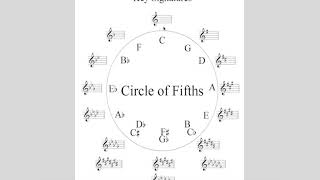
In this segment of his lecture, J. Anthony Allen revisits the circle of fifths and explains how incorporating the relative minor keys creates a richer set of harmonic possibilities. He notes that many modern graphics omit the minors, but when they are included they reveal striking star‑shaped patterns formed by moving from each major key to its relative minor and then to the next major key a fifth away. Allen also shares a brief historical aside: during medieval and Renaissance periods educators frequently used circular diagrams—not only for fifths but for various musical concepts—to teach theory, a practice that has largely fallen out of use today. He concludes by indicating he will soon display a graphic that overlays the relative minors onto the circle of fifths, setting up the next part of the lesson on chord borrowing and advanced tonal relationships.
Chapters
So now let's jump back to our circle of fifths discussion, right? We've already learned how this thing works and how we can use it for closely related keys for borrowing chords, things like that. But adding all our minor keys adds a whole kind of new wrinkle to this thing, because now we have a lot more things we can do. So this particular graphic I have here is not showing us the minor keys, but a lot of them do. And I'm going to pull up one in just a minute. But I wanted to take another quick look at this one, because before we look at that, there's kind of another interesting little kind of mystical thing inside this circle of fifths that I wanted to point out, because it just shows how kind of complex this simple idea of a circle of fifths is. This is just kind of a neat little factoid, I guess. But in the old days, in, like, medieval times, and after that, in the Renaissance and things like that, people taught music by using these circles all the time, not just for fifths, but for other stuff. There was a lot of different circles of this and that. And circles were a very common way to teach music. We don't use them anymore, really, except for the circle of fifths. I don't. I can't really think of any other time when we use circles, but they used to use them all the time. Anyway. Check this out. So C major, the relative minor of C major is A, right? So we slide like this, A major, the relative minor of A major, F sharp. So we slide like that. F sharp major, the relative minor, D sharp here, let's call it E flat, then E flat major, the relative minor, C. And so you get these kind of star patterns in here. That's not really like a thing you want to be thinking about all the time, but I think it's really fascinating how this, the circle of fifths, shows you all these different things. Anyway, now, like I said, some graphics don't show you the minors, but a lot of them do. So let's jump over to a graphic that shows us how the miners, the relative minors, lay onto this graphic.