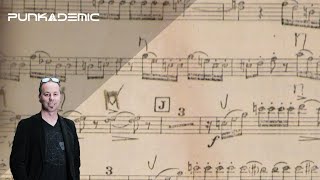
J. Anthony Allen explains chromatic modulation techniques used by Classical composers, including common-tone modulation and enharmonic reinterpretation of diminished-seventh chords. He analyzes measures 16-19 from Beethoven's Pathétique Sonata to show how E major functions as a II chord and how any note can resolve as a leading-tone regardless of spelling.
Chapters
Hey everyone. Welcome to Music theory sequence part 17. No, let me try that again. 10, 5, 7. There we go. 17. In this class we're going to be looking at chromatic modulation. So how composers at this, in this time are using chromaticism as a tool for modulation. So we're going to look at common tone modulations, chromatic inflection modulations, a couple of sort of sequency like things, a descending fifth modulation, using enharmonics within diminished seventh chords to make kind of bizarre modulations. We're gonna look at something called a voice leading chord, which is a whole new kind of chord that's kind of a mess of everything that doesn't have a term. We're just gonna call it a voice leading chord. More on that in a minute. Lots of stuff in here, lots of fun stuff. We're gonna really start to dive into how composers are navigating all of this chromaticism that's happening. So please jump in. It's a really fun class. I think you're going to enjoy it. I'll see you on the inside. Sa. We have Beethoven Pathetic Sonata. This is the second movement, measures 16 through 19. So just a little short, little four bar excerpt of it is all I'm really gonna focus on. Although this is a really beautiful piece, you should listen to the whole thing. But for now we're just gonna listen to these four bars. And really what we care about is these three bars. The modulation starts right here. And this is just a cadence. But I wanted this cadence in here to really major six with a seven on it. Okay, so we know that that's weird. So it's probably a five, seven of something. What do we have here? Here we have E major, which is going to be a two major two, which is not in key. So that's weird too. That doesn't solve our V7 issue. Right. If this is a V7 of that, neither of these are in key. So let's keep going. A little bit more G flat to B double flat again, more on double flats in a second. Just hold on to that idea for a minute. So here's one. Let's make all three. So that's one. We have one that we. The way we typically think about this is we have one that starts on C, one that starts on C sharp, and one that starts on D. So let's do the C sharting it. Here's what I'm going to do here. I'm just going to keep it the same. And I want to show you that we can use any note in a leading tone setting, regardless of how the note is spelled. Doesn't really matter. Okay, so let's do leading tone resolution.