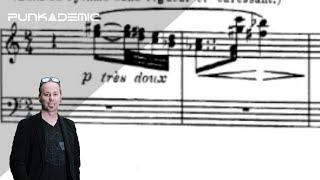
In this introductory lecture to the 20th‑century segment of a music theory course, J. Anthony Allen explains that the era demands new analytical vocabulary and methods. He outlines a shift away from traditional tonal concepts toward integer (pitch‑class) analysis, where each pitch is assigned a number, and toward set‑theoretic techniques such as collections, normalized sets, and transposition operations. Allen cautions students not to apply circle‑of‑fifths thinking to these materials, illustrating the point with a D‑centered example that leads to a 0‑6‑7 pitch‑class set (D♯‑F♯‑A) and shows how transposition of this set can generate an entire piece. The lecture sets expectations for a “head‑scratcher” experience and promises deeper exploration of 20th‑century compositional techniques in later classes.
Chapters
Hey, everyone. Welcome to Music Theory Part 18. I'm not even going to try to do the thing with my fingers anymore. Okay? So in this class, we're diving into the 20th century. So we're going to spend a little bit of time talking about vocabulary, because a lot of our vocabulary is changing, and a lot of the way that we do music theory is changing. So you have to kind of leave some things behind and think with some of the new techniques composers are using requires a new kind of analysis. So by the end of this class, we're going to get into integer analysis, where we take each pitch, assign it a number, and then start looking at how those numbers relate to each other. It tends to be the easiest way to look at music of this time. Now, as we go forward into the 20th century, that's going to be valuable. There's going to be other methods that are valuable as well. So we're going to start looking at collections, sets, a little bit on set theory, how to do normalized sets, and some tricks that I've learned to kind of analyze set theory, but kind of this looking at this clock face thing. So really, in this course, what we're really going to do is treat it as an introduction to 20th century techniques. As we go forward past this course, we're going to get deeper and deeper into the 20th century techniques. But this class is going to introduce a lot of the techniques that composers are doing at this time. So get ready for a head scratcher because this is going to be a weird one. Let's dive in. Sam, What do we feel here? Our first observations are. The first thing that I notice is there's something happening around D, right? We've got these arpeggios that keep landing on D. What happens if we build chords with it? We can. What would you get? You would get D sharp, F sharp, A. So what would that be? Be a minor third and then F sharp to A. That. This is not the circle of fifths. Okay? I even put that on this little diagram at the bottom. This is not circle of fifths, so do not get this confused with the circle of fifths. Do not think about the circle of fifths in any way whatsoever when looking at this. It has to do with the circle of fifths. Nothing. Okay, so circle of fifths 067 means this is my sonority. Okay? A 9, 3, 4 is just a transposition of a 067 and an 8 2, 3 is a transposition of a 067. Okay? I'm going to write a whole piece using 067. And I can make 067s all over the place because all I have to do is transpose this. So now, does that mean my music is going to be doing this? You know, it's going to be going up and just playing these sort of art.