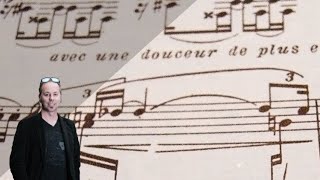
J. Anthony Allen explains how set theory represents a fundamental shift in musical language that leads to serialism. He uses pitch examples to show the complexity of chromatic material and discusses Anton Webern's highly chromatic works. Allen notes that the vertical sonorities examined share the same set class (.034), framing this dense language as essential to understanding 20th-century composition.
Chapters
Okay, so what's going to happen is the line is going to take a sharp turn, okay? It's not really a natural evolution anymore. It's a sharp turn and that's the explosion, so to speak. My term, not a normal term. And what we're seeing here, set theory, is the explosion. It's not the result of it. The result of it is going to be serialism. Okay, that's the next class. Fourth note. We have a G to a B flat. That is A. This one's going to be a little more complicated, right? Because there's a lot of notes. All right, let's do another analysis. So we're going to get into Anton Webern. So Webern is a really interesting composer. He wrote a lot of works that were very, very contemporary, meaning almost entirely chromatic. He really fell into serialism, which we haven't talked about yet. Okay, so so far, all of our vertical sonorities are the same. They're.034. Okay, so if you're like most people in a Music Theory 4 class, then at this point you're thinking that this is dumb. You're thinking, why? Why do all this? It's so complicated and it doesn't really sound very good, right? Like this chromatic music just doesn't sound very good, so why bother?