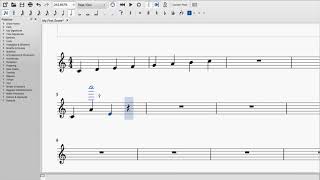
J. Anthony Allen composes a simple melody in C major to show how the fifth scale degree creates a natural pull back to the tonic. He walks through the whole-step/half-step pattern, starting and ending on the root, and staying within the scale. The next lesson will analyze a familiar melody using these same principles.
Chapters
Okay, so now we know how to make and find a major scale. Let's talk about how to use it. So what I want to do here is I'm going to write a melody and I'm going to point out a couple things about using the major scale that are important to keep in the back of your head. So let's first just write a major scale. Let's stick to the key of C here because we like C. C is easy. So I'm just going to write in a C major scale just so we can see it and use it for reference. There we go. Now we know this is a major scale just because we look at it. It's all there. There are no accidentals in it. So that tells us for one thing that it's a major scale. All also, we could go through and pick apart the half steps and whole steps pattern, right? C, D is a whole step, whole step, half step between E and F and then et cetera, et cetera, another half step between B and C. So that is a major scale, a C major scale. C is the tonic. Okay, so let's write a melody. Now what I'm going to write here is I'm going to try to write a very typical melody, meaning I'm going to follow the rules. It's not going to be the most interesting melody you've ever heard, because it's going to follow every rule and do everything as expected. But it's important to understand those kind of fundamental ideas. So when we write a melody, typically, and we don't have to do this, but typically we start on the root and we're probably going to end on the root also. And the root, sorry, the root is another word for tonic. Okay? So tonic and the root are the same, have the more or less the same meaning. So I'll try to use tonic, since we just talked about that. So we're going to start on the tonic for our melody and we're going to end on the tonic also. Either octave would be fine. I could start up here or down here. Now, we want to pay special attention to the fifth note. The fifth note of the scale has. It's what we call a tendency tone, meaning it kind of pushes things to go a certain way. And what the fifth note does is it pushes everything to go back to the tonic. Now you can think of that as like. We'll talk more about this later, especially when we get into chords. This will become a big deal. But you can think of this note as. I think of it as like this is a weird analogy, but as like lily pads, right? So imagine a frog jumping back and forth like this is home. This is the other thing. They can jump between these two spaces, but whenever they're here, they're really just waiting to jump back to here. So this makes it feel like we want to go back more on that when we get into chords. But. But we're going to use that somewhere where we want it to really push back to tonic. Right? For example, the second to last note is a great place to use it because we want the last note to be tonic so that it feels like an ending. And this will make it feel like we're going to tonic. So that works quite well. So let's just randomly put some notes we'll do. We can jump around. Let's go A, E. Let's maybe make that a half note. There we go. And then we'll do some eighth notes. It's kind of a weird little jump. But then we'll go. Okay, now I'm gonna use that G. So I'm gonna. I'm approaching the end, right? So I'm gonna put the end right there. So that's tonic again, right to C. So let's put a G right there because that's the fifth note of my scale, which is gonna make this feel like this note is gonna lead to there because it's one of those tendency tones. More on tendency tones soon. So let's hear my little melody. It's short, but it's cute. You know, it's nothing fancy. I stayed completely in the key because I didn't. Or in the scale because I didn't go outside of any notes. I used only white notes in this case because that's what is in the key of. Or the scale of C major. And then it's kind of bounced around. Used some different stuff. This note I thought was maybe a little weird. Maybe I'll change that one to maybe there. I can use G again. That's totally fine. So I just kind of meandered around a little bit and then I ended on C with a nice tendency tone pushing me there. So that's kind of how you can use major scales. Really what I've done here is I just bounced around within it. You know, I'm not going to go outside of it. I'm going to only use notes in that scale. And my melody is going to sound pretty fine. Just using those. You can add a little tendency tone if you want. You don't need one, but it helps. But I wanted to introduce that idea of a tendency tone, we're going to see it a lot more when it comes to chords. Okay, up next, let's take a look at maybe a familiar melody and see if we can dissect it and figure out what key it's in and what they're doing with it.