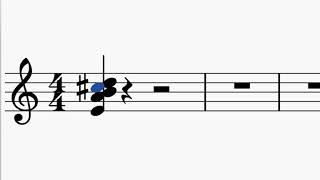
In this introductory tutorial, J. Anthony Allen defines chords as any group of notes sounding together, whether simultaneously or spread out, and emphasizes that music theory is fundamentally about finding notes that sound good together. He demonstrates a poorly sounding chord to illustrate that not every collection of notes qualifies as a useful chord. Allen explains that rather than memorizing chord shapes, learners should understand the underlying patterns that make chords harmonious. He outlines the primary chord families—major, minor, diminished, augmented, seventh, ninth, and thirteenth—while focusing initially on major and minor chords within a key. He connects chord construction to scales and keys, previewing a series of upcoming videos that will teach how to spot, label, and analyze chords using Roman‑numeral analysis, first with a cursory look at a piece of music and then with a detailed theoretical breakdown.
Chapters
Alright, it's time to start talking about chords. Now, when we talk about chords, what we're really starting to get into here is what notes sound good together at the same time. Now, if you remember all the way back to the beginning, my kind of motto when it comes to music theory, at least the basics of music theory is it's all about what notes sound good together. Right? That's what we're trying to figure out. So chords are really where the rubber hits the road in terms of things getting more complicated. Things are about to get a little trickier, but not too tricky. Don't worry, that's my job. My job is to hold your hand through it and make sure it doesn't get too daunting. Okay, so what is a chord? A chord is, simply put, a group of notes. Any group of notes can be considered a chord. So let's just, let's just do it. Let's put, let's do a quarter note here and let's say, I don't know, I'm just gonna blindly play some notes. Here's, you know, let's throw A sharp in there, B sharp. Let's not do that. Let's throw, let's throw a C sharp in there, something like that. Okay, here we go. So I've made here a chord. A chord is a group of notes at the same time. Let's hear that chord. Okay. It's not a particularly nice sounding chord, right? But it is a chord. It's a bunch of notes happening at the same time. Chords can also be splayed out so they don't have to be played at the same time to be considered a chord. We'll talk more about that later. For now, we're just going to focus on notes played at the same time. So this particular chord is an ugly one, right? What we're gonna do is we're gonna start figuring out how to assemble chords. And we're not gonna do it by just memorizing a bunch of chords, right? A bunch of notes that go together. That's not particularly useful in my opinion. The useful way is to figure out what makes a chord, what is what makes a good sounding chord, and teach you how to figure it out. Right? So just like we saw with scales and we saw the pattern of whole steps and half steps in chords, there are patterns. There are patterns to make a couple different kinds of chords. And everything can be based around those couple of patterns. So that's what we're going to focus on for the next couple videos. So this particular Chord that I've drawn on the screen does not follow any of those patterns. It's a chord because it's a group of notes, but it didn't follow any pattern that makes it a good sounding chord. So similar to scales, we have a couple different kinds of chords that we'll encounter. We have major chords, we have minor chords, and then there's a couple others, actually. There's something called diminished chords, something called augmented chords, something called seventh chords, ninth chords, 13th chords. We're going to get into all of those eventually. But for now, we're going to focus on major and minor chords as they exist in a key. So we know what keys are, we know what scales are. We're going to need both of those things in order to figure out how to build chords. So with that, what I want to do next is I want to look at a little piece of music. We're going to look at one that we just looked at a few minutes ago, but we're going to look at the chords. And what I want to do in the next video is just give us a quick little overview, a quick little run through, spotting the chords, talking a little bit about the chords. And then what we're going to do is we're going. I'm going to go through a whole bunch of videos talking to you about how to find chords, how to label chords, how to know if they're major or minor, and how to see where they fit in the key and in the scale. Then we're going to look at that same piece again, and we're going to actually analyze it in a kind of a strict music theory kind of way. We're going to use this Roman numeral system that everybody uses. It's going to be great. So we're going to look at the piece first, just for like a kind of cursory overview. And then we're going to go into the nitty gritty of how chords work. And then we're going to look at the piece again. Cool. So let's jump in. Let's. Let's look at this, at this piece.