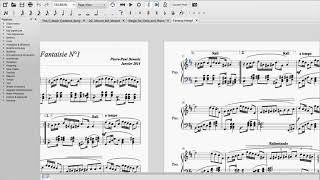
J. Anthony Allen explains how key signatures work: the sharps or flats at the start of a musical score tell you the piece's tonal center. No accidentals means C major, one sharp means G major, two sharps means D major, one flat means F major. The accidentals apply to every occurrence of that note across all octaves.
Chapters
So let's look at this piece. Whenever a piece starts, this is this elegy for cello and piano that I think I've used a few times in this class already. Whenever a piece starts, at the very beginning, we see three things, right? In a row, these three symbols, right? We see the clef, the key, and the time signature. It's always in that order. Clef key, time. So you can kind of burn that into your head. Clef key, time. So we know what the clefs are, right? The clefs tell us the general range of. Of what's going on. The time. We know what that is, too. So it says 4, 4. There's four beats per measure. Four quarter notes per measure. I should say 3, 4. There's three quarter notes per measure, et cetera. This one is the C is kind of a shorthand for common time, which basically means 4, 4. So it's kind of a different way to write 4, 4. The key is what we haven't talked about yet, right? So clef key, time is the order. Now, what the key is is it is a symbol. And it can be a number of symbols that are in that spot right there. And they tell us the key of the music, the key that it's in, in a way that you can just look right at it and know exactly what key you are in. So let's look at another one. Okay, here's another piece. Here's this fantasy piece, okay? Clef key, time. There's nothing here, right? There's nothing in between clef and time. That means the key signature of this piece is no symbol, which means it's in the key of C major. If there's nothing, it's the key of C major. That's the rule. This piece happens to change keys, right? Let's look over here. Now we have clef key. We don't have time because it's not the beginning of the piece. We don't need the time signature. The time signature hasn't changed. But now we have a key. And this has two sharps floating there. That tells us exactly what key we're in. And in this case, it tells us we're in the key of D. Two sharps tell you that you are in the key of D. One sharp tells you that you are in the key of G. No sharps tell you that you are in the key of C. And here's another piece with one sharp. So that's in the key of G. This one, the C major song we were just looking at, has no Sharps. So it is in the key of C. It can also have flats. If there's one flat than in the key signature than you are in the key of F. Don't worry about all these things. I'm going to tell you a trick to remember all of that stuff in the next video. So what the key does is. Let's look at. Let's look over here. Let's look at this one measure right here. Okay, so here's the key signature. It's got two sharps. Now those two sharps happen to be just kind of a floating F sharp and a floating C sharp. Okay? That's what those two are. That means all Fs that happen in this whole piece are going to be F sharps. This is what's tricky about playing one of these pieces sometimes that you have to remember the key signature always. So this is actually going to get played as an F sharp. This is going to get played as a C sharp because it's in the key signature. You always have to remember the key signature. Right? So let's move forward. We can still change notes. We can still add stuff, see if we can find a natural somewhere. Nope, no naturals here. But you might see sometimes a natural. Let's just add one. Let's say here. Okay, if we saw this, this would mean this natural sign would be used here to tell you to ignore the key signature. Right? Because this tells us all Cs that happen in this whole piece are to be played as C sharps. That's what the key signature does. It kind of lays a template over the whole piece and says all Cs are now C sharp. That's what the key signature says. This symbol says, except for this one. This one play as a C natural. A normal C, not a C sharp, F sharp. So all things, all Fs are F sharp, regardless of the octave. Also very important to know. So this is an F sharp. We're in bass clef down here. So this is an F sharp, right? All Fs are F sharp, even. Let's do the same octave here. There's an F and there's an F. My key signature says all Fs up here are sharp on this top line. But it applies to all octaves. So this one is sharp as well. So when you're playing a piece, you have to remember the key signature all the way through. This is why playing in C major is easier. Because you don't have to remember a key signature. But you know, you get used to it. You learn to just kind of keep it in mind the whole time. So in the next video, let's walk through. First of all, the trick for remembering or figuring out what key signature goes with what key. There's a fairly simple pattern to it. So let's talk about that next.