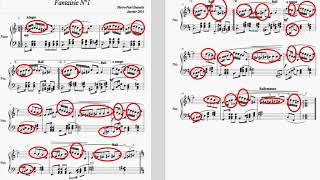
In this instructional video, the presenter explains why scales are fundamental to music theory. He begins by recalling the typical early‑lesson experience of learning major scales and admits that scales can feel boring to play, but emphasizes that they reveal a recurring pattern that serves as a template for analyzing melodies, harmonies, and chords. By comparing musical material to a scale, one can identify the key, detect when the music moves outside the scale (modulation or chromaticism), and understand chord construction, since chords are built from selected notes of a scale. The presenter demonstrates these ideas with a short piano excerpt from MuseScore, showing scale fragments that indicate the piece’s key and how chords derive from the scale. He concludes by previewing the next video, which will define the terms “chromatic” and “diatonic,” concepts essential for deeper scale analysis.
Chapters
Okay, let's talk about scales. Now, if you've ever sat down to learn an instrument, one of the things you probably did in one of your earlier lessons was to learn how to play some scales. Probably a C major scale, maybe a B flat major scale, maybe a G major scale. Depends on the instrument. Why? Why do we care about scales so much? I wanted to point this out because I remember learning how to do this and thinking, I am so sick of scales. These, they are so boring. And they are. They're quite boring to play. But from a music theory perspective, what scales do is they show us a pattern. And that pattern we kind of can use as a template to see almost all of music. So we look at that template and we kind of put it over top of. Of all kinds of melodies and all kinds of harmonies. And that shows us what's going on. We basically compare it to a scale. We compare the music we're seeing to a scale. For example, in this piece of music that we're looking at here, this is just kind of a random piece I found on the musescore website. But it's a nice little piece. We see little scale fragments all over the place. In those scale fragments, I can tell what key we're in because of those scale fragments. I can tell when we go outside of that scale, meaning we're changing keys or we're just doing something. Not entirely, let's say predictable, which is okay, which is preferred. It's actually great. I can also compare scales to all of these chords that I see. The left hand of this piano part, all of those chords are made from scales. Scales make up chords. Or, let me. Maybe it's more accurate to say that backwards chords are made from scales. That's a better way to say that chords are made from scales. So we take a scale, we take certain notes out of the scale, and that makes a chord. That's exactly how chords are built. So we. We can't really build chords until we understand how scales work. And we can't build melodies that stick to certain keys until we know how scales work. So melodies, harmonies, kind of everything is built around different scales. So we have to know how they work if we're going to understand really anything about a piece of music. So let's dive in. So up next, I want to talk about a couple different definitions, particularly the words chromatic and diatonic. These are two words that I'm going to use a lot, and we need to get very familiar with them. So let's dive over into a new video and talk about that.