In this instructional segment, the presenter walks through how to determine the seven diatonic triads that belong to any given key by first writing out the scale, deriving the key signature, and stacking thirds on each scale degree. He clarifies that there are only seven distinct chords (the eighth is an octave of the first) and emphasizes that students may need to write the process out rather than compute it mentally. The lesson then shifts to the problem of identifying a chord’s quality when it is presented out of context—without a known key. Using an A‑root triad as an example, he shows that while the root can be identified, the chord could be major in the key of A or minor in the key of G, illustrating the limitation of relying solely on diatonic progression. He promises to explore more scientific methods for discerning major versus minor chords without key information, stressing the need to dissect a chord’s internal structure.
Chapters
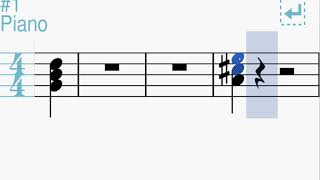
Okay, so we've looked at how to find triads given a key. So if I tell you, you know, we're in the key of G, after a little bit of work, you should be able to tell me now, seven chords that work in the key of G, their roots, and if they're major or minor, right? Because the process you would do for that is first you would write out the scale, figure out the key signature based on the alternations of half steps and whole steps, right? That would get you all the right notes in the key. And then you would build a chord on each of those notes by assembling every other note of the scale, starting on each note of the scale. That would get you that diatonic chord progression, right? And then using the pattern of major and minor chords that we looked at the diatonic chord progression pattern, you would be able to tell me if any of or which of those are major and minor. And the one weird diminished one, right? So, you know, you might not be able to just do it in your head. You might have to write it all down. And that's totally fine. You know, you don't have to be able to do this in your head, but you should be able to tell me those things. Given a key, that would tell us seven possible chords that work in that key. And if you're thinking, I thought there were eight, remember that the eighth one was the same as the first one, right? Just an octave higher. That's the way I did it before. So try not to get confused by that. There are seven different possible chords, major and minor chords, in the diatonic chord progression for any key. Now, with that, I want to take a look at other things inside the major triads, things we need to know about them. For example, what if we don't know the key? What if we're just. Let's look out over here. Let's just say, what if I just did this? Okay? What if I just gave you that completely out of context? We don't know what key we're in. We don't know anything. How can we tell if that's a major or a minor chord? Right? We don't have enough information just by looking at that chord to use the diatonic chord progression. Because we don't know what key we're in. We don't know what scale degree this is based on. We can tell it's in root position because it's stacked in thirds, right? It's got that nice alignment. But we don't know if. So we know this note A is the root of the chord. We know that for sure. But if we're in the key of A, it's going to be a major chord. But let's say we're in the key of G, right? Then it's going to be the II chord, because g would be 1 and a would be 2, and then it's going to be a minor chord. So how can we tell if this is a major or minor chord when we're just looking at a chord completely out of context? So that's what we're going to look at in the next couple videos, is how to really see inside the chord and figure out what's in it. Aside from using the diatonic chord progression formula, there are ways to do it. There are ways to know this is a major chord. I can tell you that confidently for a couple reasons. One of them is just that I happen to know have memorized a C sharp. E is a major chord, but there are more scientific ways of knowing that. So that's what we're going to look at in this next section. We're going to dissect a chord and look at what's inside it so we know how to build it when we are out of context. Okay, so let's dive in.