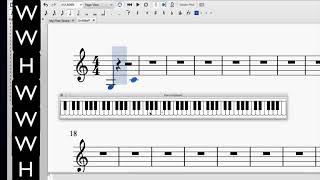
In this instructional video, J. Anthony Allen explains that every major scale can be generated from a single, universal pattern of whole (W) and half (H) steps: W‑W‑H‑W‑W‑W‑H. He first defines a half step as the smallest interval between adjacent notes (e.g., C → C♯, B → C) and a whole step as two consecutive half steps. Using this definition, he demonstrates how to build a major scale by applying the pattern to three different root notes: C (all white keys), G (introducing a single sharp), and B (a scale with many sharps and an enharmonic spelling issue). Throughout the examples he highlights the role of accidentals, the concept of enharmonic equivalents (e.g., A♯ = B♭), and the connection to key signatures. Allen stresses that memorizing the W‑W‑H‑W‑W‑W‑H pattern is essential for constructing any major scale and will be repeatedly used throughout the course.
Chapters
All scales can be kind of diluted down to this very well, to a unique pattern. So important to remember, each scale has a different pattern. And in fact, you can define the scale by the pattern. You know, you can just say the pattern. And anyone who knows music theory really well will know how to put together that scale. So let's just dive right in and talk about the pattern for the major scale. Now, when I talk about the pattern, this is a combination of whole steps and half steps. Now, just a quick review. A whole step. Well, let's do a half step first. A half step is a note to the next closest possible note, right? So C to C sharp is a half step. B to C is a half step, right? It's the closest possible note that it can go. A whole step is two half steps, basically. So a whole step from C up would be to D, because C to C sharp would be the half step, and C sharp to D would be the whole step, right? A whole step from D is going to be E because there's one in between. It's another way to think about a whole step is that there's going to be a key in between or a note in between. So here on E, the whole step is going to be F sharp because there's a key in between. So a half step to F and then a half step to F sharp gets us to the whole step. So the pattern for a major scale looks something like this whole, whole, half, whole, whole, whole half. Now, you're gonna hear me say that a billion times. That's super important to remember, because that combination of W's and H's is the major scale. Wwh, W, W, W, H. Key to note is. There are only two half steps in it, right? So here's how we use that. Let's look at our piano keyboard. In fact, I'm just going to turn on the note entry here, and let's do a C scale because this is the easiest to see. And this is why we like to use the pitch C to show. To talk about major scales, because it's going to end up being all white notes. Because that pattern of whole, whole, half, whole, whole, whole half happens to be the order of the white notes where our half steps line up. Right here, I'll show you what I mean. Okay, so let's start with C. So I'm going to hit a C. Now I'm going to go a whole step that gets me to a D. Now I'm going to go a whole step that gets me to An E. Now I'm going to go a half step. That gets me to an F. Now a whole step, another whole step, another whole step gets me to a B. And another half step gets me back to a C. And therefore, by following that pattern, we have created a major scale. So all we have to do is put that pattern on a note and then follow the pattern of whole steps and half steps from there, and we will have created a major scale. Let's try it on a different pitch. Let's try G. Okay, so here's a G. Let's move down just a little bit here. Okay, so this is a G. So let's go. Let's just do our pattern. Whole step, whole step, half step, whole step, whole step. Now here's the tricky one. Whole step gets me to here because this is a half step. This is a whole step. And then half step gets me back to G. Now you should, if you did this right, you're always going to begin and end on the same note, G and G. Okay? And also, if you did this right, the only one of these, the only major scale that's going to be all white notes going to be the C major scale. That's the only one that's all white notes. Every single one of these is going to be different depending on what pitch you start on. So now we have a G major scale. Right? Let's do one more. Let's do a weird one. Let's do one with a lot of accidentals. Remember, accidentals are notes with a symbol in front of them. Flat or sharp. Let's do. Let's do B. This is probably one of the weirdest ones. So let's start on B. And we're gonna go whole step that gets us to C sharp. And we're gonna go whole step again gets us to D sharp. Now pause here for a second. You'll notice my notation program wrote C sharp and then E flat. That's not really what we want it to do. We want it to write D sharp because we. Some keys, some scales we usually talk about in sharps and some we usually talk about in flats. And B is a sharp key. We'll talk more about that later when we talk about key signatures. But I'm going to switch this just manually to a D sharp. And this is something that computers just don't really know. They don't really know if you want it to be D sharp or an E flat. Okay, let's continue on. Let's start over. So B to C sharp is a whole step to D sharp is a whole step. Now we need a half step gets us to E, and then we need a whole step gets us to F sharp. And then we need another whole step to G sharp. Another whole step to A sharp. Put a B flat. I'll correct that in a minute. Then a half step gets us back to B. Okay, so we're all in sharps here, except for that one note. So I'm gonna fix that. There we go. So, same note. I just spelled it enharmonically, if you remember that word from the first class, enharmonically means I'm just respelling a note. So B flat and A sharp are enharmonic notes. They're the same thing, just different. So here's our scale. Now, this might be a lot to remember, right? We have to remember that there's five sharps in this thing. But if you just remember the pattern of whole steps and half steps, you'll remember how to make that. So etch that into your brain. Whole steps and half steps. I'm not going to tell you a ton of things in this class that I'm going to say. You have to memorize this in order to really understand this. I'm not a big fan of memorizing things. However, this is one thing that you should memorize is this pattern of whole steps and half steps. It is crucially important. So we're gonna do it a lot of times in this class. I'm gonna build a scale, and I'm gonna say whole steps and half steps, and that's how we're gonna do it. So memorize that. Okay, Next, let's dive into a little bit of terminology so we can kind of dissect what we have here, what we have in our major scale.