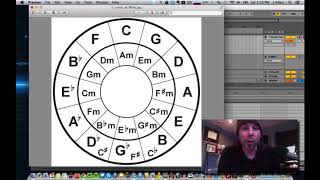
In this tutorial, the instructor introduces the Circle of Fifths as a visual tool for understanding key relationships in music composition. He first situates the lesson within the broader series on music theory for electronic musicians, reminding viewers of prior topics such as chord construction, key identification, and chord functions. The Circle of Fifths is presented as a diagram that simultaneously displays (1) the relative major‑minor pairings, (2) the sequence of perfect fifths (and, when traversed in reverse, perfect fourths), and (3) the tritone (diminished fifth) relationship, which lies opposite each other on the circle. The instructor demonstrates how to count up by five to move clockwise around the circle, explains why the same diagram can be called a “circle of fourths” when read counter‑clockwise, and audibly illustrates the dissonant tritone interval. He notes that while the diagram is rarely posted in professional studios, knowing how to read it is valuable for rapid key‑related decisions during composition. The video ends with a teaser that the next lesson will explore the most practical compositional uses of the Circle of Fifths.
Chapters
Welcome back. So next we're gonna talk about this thing called the circle of fifths. So you might have seen this before if you took any kind of music lesson or anything like that. And you might have seen it and just said, that just looks like a crazy symbol. And I don't know why that weird little diagram has anything to do with my life. It's like these stereotypical image to hang in your fourth grade music room if you had one. So it gets kind of a bad rap. But I want to show you why that's important to us as we get into some of the compositional things about music theory. So let's talk about that for just a second. So what we've done so far, and from music theory for electronic musicians one and music theory for electronic musicians two, we've talked about chords, how to figure out chords, how to figure out the key, how to assemble chords once you know the key and what each chord does. So we have major chords, we have minor chords, we have minor keys. We've got all the different chords within the key and all the different patterns for figuring out the keys and the chords. So the next kind of big topic, well, actually the rest of this class more or less, we're going to be working on how to a couple things you can do to create music. So when you're creating how you can use theory to help you create. So we're going to be talking about a lot of different kinds of stuff, but a lot of these techniques are going to be aimed at creating. We're still going to do a bunch more analysis because from what I heard from the first class, that was something that a lot of people wanted. You know, the joy of an online class is that if you don't want to want to look at those analysis things, if those aren't interesting to you, then you just skip right past them. I'm not going to grade you, so it doesn't even matter. If you don't like them, skip past them. It's all good. But I do think they're valuable to look at how different songs work and sort of see this stuff in practice. Okay, so let's look at this thing called the circle of fifths. So here it is. Let me get it. Nice and big for us. Okay? So if you just Google around, you'll find a whole bunch of different versions of this. So what I'm going to do first is just explain what it is, and then we'll cut to the next video and we'll show how you can use it. When you're writing a track, there's a bunch of different things we see in here. This shows us several things very efficiently. The first thing that shows us is the relationship of the relative major and minor. So we can see here that it's outlining all of the major keys and major chords along the outer circle and the relative minor on the inner circle. So we can look at C. And we know that C, the relative minor of C, is A minor. If I'm in the key of A minor, the relative major is C. It goes both ways. So that's a hand. It's a handy diagram to see all those really fast. So if you're in the key of E, we can tell that the key of E, the relative minor is going to be C sharp minor. So if we have the circle of fifths hanging around, we can just see that really fast based on this diagram. That being said, I don't expect you to print this out and hang it up in your studio. I've never gone into a recording studio that had a poster of the circle of fifths on the wall. I don't know what I would think if I did walk into one. But regardless, it's good to know you can also figure these things out for yourself. You know how to figure out the relative minor of all these keys based off the scale and the pattern going around while seeming random is just counting up by five for every note. That's why we call it circle of fifths. So C in the key of C, that's important. If we count up five, remember, C is all the white notes. So C, D, E, F, G. So a fifth away from C is G. If we're in the key of G and we count up five, it's going to be G, A, B, C, D. That gets us to D in the key of D. If we count up five, we get to A. In the key of A, when we count up five, we get to E and so on through all the notes, we count up five, we'll always end up at the next note in this circle until we get all the way to F. And then we count up five and we get back to C. So it goes all the way around in a circle. Hence circle of fifths. Now, sometimes you'll come across this and it'll be called the circle of fourths. Why would it be called a circle of fourths? Because a fifth upside down is a fourth. So if we go backwards, so this way it's fifths. If we go this way around, it's Actually, a circle of fourths. So C to F, C, D, E, F, that's a fourth. So a fourth away from C is an F. F to B flat is F, F, G, A, B flat. I should probably do that with these fingers. F, G. A B flat is a fourth away from F. So that's the second thing it tells us, is it tells us fifth relationships going around. It tells us fourth relationships going around. And it tells us our relative major and minor going around. There's one other thing it shows us. Actually, there's two other things that it shows us, but there's one more that I'm going to look at right now, and that is it very quickly shows us the tritone. Now, the tritone, I don't think I've mentioned the tritone yet, but it's sometimes called a diminished fifth. Doesn't matter. What it is, is. It's the ugliest note, ugliest harmony we've got. And you can find it by going directly across the farthest thing away. So D flat to G is the tritone. Those are the ugliest two notes you could play together. So C down across to G flat, Those are the ugliest notes. So if you just go straight across the thing, E flat goes to A or C to F sharp, actually, it would be the same. So if you go straight across, you find the tritone. Now, the tritone is this weird. Oops. This weird sounding interval. It doesn't sound good. Let's make one. So there's a C. If we go C directly down, we get a G flat or an F sharp, same note. There's one. So let's do like this. Let's make these nice and long. We'll hear them one after the other. Okay, now we're going to alternate between C and F sharp. This is the tritone interval. It's the halfway point on the circle of fifths. It doesn't sound very good. Sounds a bit like a British siren. Let's hear them at the same time. So that tritone sound is generally considered one of the most dissonant things we can do other than a minor second. You know, doing that. The two notes right up on top of each other, but very close to it would be the tritone. Now, there are ways to make the tritone sound good. So that's the third thing that we find in the circle of fifths. Now, the fourth thing is the thing that's the most useful to us as creators of music, either producers or songwriters or whatever you actually are. And that fourth thing I'm going to leave as a surprise and push us over into the next video where we're going to deal with just that fourth thing. So circle of fifths. The three things that we talked about seeing in it are the relative majors and the relative minors through these connections, the pattern of fifths all the way around, pattern of fourths all the way around, and the tritone relationship by cutting straight across. So tritone is ugly, but sometimes useful to know. Okay, see you in the next video.