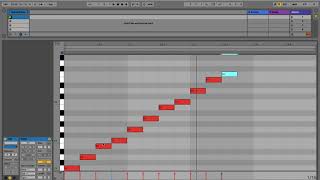
In this instructional video, J. Anthony Allen explains musical modes as variations of scales, focusing on how they relate to major and minor scales and how they can be generated by shifting the root of a familiar key signature. He uses the Lydian mode as a running example, showing that it is a major‑type mode created by raising the fourth degree of a major scale. Allen then demonstrates the root‑shift method: taking a C major scale and treating the fourth note (F) as the new root yields F Lydian, while treating the second note (D) as the root yields D Dorian, illustrating that each of the seven modes can be derived from the same set of notes by re‑anchoring the tonic. He outlines the sequential order of the modes (Ionian, Dorian, Phrygian, Lydian, Mixolydian, Aeolian, Locrian) and notes which are major‑type and which are minor‑type. The lesson emphasizes that every mode is tied to its “closest brother” – a major or minor scale – and that proper alteration of that scale (e.g., raising the fourth for Lydian) produces the mode. Finally, Allen hints at a brief historical overview of modal theory, setting the stage for deeper exploration in later lessons.
Chapters
Okay, what are modes? Modes are scales. There are a bunch of different kinds of scales. They kind of come in a pack. There are seven modes that we use. There is an order to them. There is a sequence of them. You can use them however you want. Some of them are popular in different styles of music. Some of them give us kind of a Brazilian sound. Some of them give us kind of an Eastern sound. Some of them give us like a jazz blues sound. But at the end of the day, they are a sequence of scales that we use to make melodies, riffs, and to some extent, harmonies. So how modes work? There's two ways to think about modes when you're looking at them. We can look at them in relation to major minor scales like I was just talking about, and there are alterations to them. Let's take for example, this one called Lydian. We're going to go over Lydian mode more in a minute. I just want to kind of use it as an example to explain how modes work. So Lydian is actually the one I did just in the previous video, where this note is 1 higher. This is called Lydian. The Lydian mode, you could also say a Lydian scale. What we've done here is we've taken a major scale and we raised the fourth scale degree, right? That's all we've really done. So we're going to look at these in two different ways. That's one way. The first way is looking at either a major or minor scale. And all of the modes are a type of major or a type of minor. So this one, Lydian, is a type of a major scale. Other ones are types of minor scales. They all can be related to a major or a minor scale. So that's the first way we're going to look at its closest major or minor scale. So if it's a major type mode, we'll look at the major scale and then we'll see what we need to do to alter the major scale to get it into that mode. In this case, we just need to raise the fourth scale degree and we get into a Lydian mode. But there's another way to look at it. Another way to look at it is by just moving the root. And this is where things get a little hairy at first. If I explain this right, then this is an easier way to understand modes. But it's kind of hard to explain. So let me try see if we can end up on that same scale. So all we really need is a raised fourth. Here's what we're going to Do. There's an order to the modes. They go in an order. This one that we're looking at is the fourth one in a series. So just trust me on that. We're going to look at the whole series in a minute. So this is the fourth one. So what that means we can do. If I take a C major scale, I'm going to use C, for example, I go up to the fourth note, okay, because it's the fourth one. Now what I'm going to do is I'm going to treat that as the root of my scale, but I'm not going to change any notes. So stick with me here. What that means is that I'm going to do a C major scale, but instead of going from C to C, I'm going to do a C major scale, but go from F to F. So let's keep going up the C major scale until I get to an F. And let's get rid of these and that. Okay, so now I have only white notes here, right? So that means we're still using using a C major scale, but I'm treating F as the root of the scale instead of C. So all the notes of C, or another way to think about that, is the key signature of C, but using F as the root. So I'm using the wrong root with this scale. That actually makes a mode because check it out. Remember our pattern for a major scale. Whole step, whole step, half step. That needs to be right there. So if this was a major scale, that would be down. The rest would be the same, but it's not. It's right there in this thing that we just made, which means that fourth scale degree is raised, which means it's a Lydian mode. Let's do another one. Let's go backwards. Okay, I'm back to my C major scale. Let's make another one. Let's build the second one. The second one in the series is called Dorian. So what I need to do for Dorian is I'm gonna use a C major scale. I'm gonna go. But I'm gonna go from D to D. Now I have a Dorian scale because I have all the notes of C major, but I'm gonna go from 2, 2, 2. And because this is the second one in the sequence, it's a Dorian scale. So this pattern of modes, there's one based on C, there's one based on D, there's one based on E, there's one based on F. But if I change my starting point, I could say, let's do a D major scale. Now I'm on a D major scale. So now if I make a Lydian scale using the D major scale as my starting point, I'm going to make a G Lydian scale. Okay, we're going to do this over and over as we go through each mode. So if that didn't quite make sense, I think it'll lock in once you see it in action a couple times. So the thing to remember is from this lesson is all modes can be tied back to either a major or a minor scale. It's kind of their closest brother, so to speak. So that Lydian one we looked at, its closest brother is a major scale. That Dorian one we looked at, its closest brother is a minor scale. They all can go back to a major or minor scale and we can alter that scale to get the mode if we want. Second thing to remember is any mode can be found by just shifting the root of another key. Or another way to put that would be use a major scale, but put the wrong key signature on it and you'll end up with a mode if you do it right. That doesn't mean you can just slap any key signature on any scale and end up with something that sounds interesting, not true. So we're going to look at more as we go into them. Before that, though, let's take a little stroll through the history of modes because it's kind of interesting.