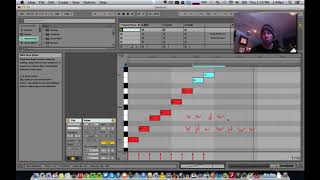
In this instructional video, J. Anthony Allen introduces minor scales for electronic musicians, beginning with a common misconception that the presence of minor chords automatically means a piece is in a minor key. He explains that a key is defined by its overall arrangement of major and minor chords, and that a dark‑sounding progression can still belong to a major key. The lesson then shifts to the construction of the natural minor scale, contrasting its whole‑step/half‑step pattern with that of the major scale. Allen demonstrates the pattern (whole, half, whole, whole, half, whole, whole) and shows how the minor scale can be derived from a major scale by lowering the 3rd, 6th, and 7th degrees by a half step. He plays the resulting natural minor scale to illustrate its darker timbre. Finally, he notes that there are three “flavors” of minor scales (natural, harmonic, and melodic), setting up future lessons that will explore the other two types. The tone is conversational and enthusiastic, aimed at helping producers understand and apply minor scales in their music.
Chapters
Okay, here we go. So we're gonna dive into minor scales now. Now this is good. I'm excited that we're getting to this one because this is one that. From the first class, I got a lot of emails about this one saying I really want to do minor scales and learn minor keys, because a lot of the music I listen to and that I'm interested in producing is. Is in a minor key. So I want to point out one thing about that before we dive into this is that just because a song uses minor chords doesn't necessarily mean it's in a minor key. We saw that when we looked at even something like that last piece we analyzed. There were minor chords in it, even though it was in a major key. So any key is an arrangement of major and minor chords and some other ones sometimes. So a chord progression might sound dark, but still actually being kind of a major key. Now, that being said, if it sounds really dark, it's probably in a minor key. And for the kinds of music that I think most people watching this class are interested in, minor keys are important. You do want to work in minor keys at least some of the time, maybe not all the time. So let's dive in, shall we? So what we're going to do in this lesson is talk about the minor scale. Okay, so we know the major scale. The major scale is a organization of half steps and whole steps, right? The minor scale is also. So let me throw our major scale on here.
So we have whole step, whole step, half step, whole, whole step, whole step, whole step, half step.
So the thing to keep in mind here, that's what it sounds like. Let's maybe slow that down just a touch without moving my grid. Okay, Thing to keep in mind here is where are the half steps? They're right here and they're right here. Okay, so the minor scale is also an arrangement of whole steps and half steps. The only difference really is that the half steps are in a different place. The arrangement of half steps in a minor scale. Well, the arrangement. The pattern. Let's just. Let's just dive in right to the pattern. So let me use. Okay, so the pattern is. Let's just write it down here somewhere.
Whole, half.
So we have a half step right away.
Whole, whole, half, whole, whole.
So that's our pattern.
Whole, half, whole, whole, half, whole, whole.
So you can see that's different than. Let me write the major. I'll write the major right above it.
Okay, so this is major here, and this one is minor. Let's write minor. So before we hear this, let's analyze this a little bit. Let's just have a look at it. So we still have two half steps in the minor scale. They're here and here. So they're the second, third, fourth, and fifth. So if you look close at this, and this isn't something we're going to talk about right away, but we're going to talk about it real soon, like the next video or maybe two videos from now. There is actually a looping pattern that happens here.
Whole, whole, half, whole, whole, whole, half.
Right. You can find that pattern in the minor scale if you start it right here.
So the major scale from here to here is the same as the minor scale. Right. The same pattern happens if you start it here. Now that'll be important in a minute, so just file that away. We'll. We'll want to remember that, but for our purposes right now, we don't exactly need it, but remember it. Okay? So let's organize our pitches correctly. Let's get rid of my notes here. So we have whole to here. So that's whole and then half right there. So we have whole half, and then
whole whole steps, and then half step.
And then from this half step, we need a whole step, which this is now bigger than a whole step. A whole step is two lines here. So take that one down too. That's a whole step now, and then a whole step again. So this. Now we have a minor scale. Now if you were paying attention. Let me do that one more time. I'm going to restore the major scale. All we really need to do to convert a major scale to a minor scale is to take the third, go down the sixth and go down, and the seventh and go down. That is the fundamental difference between a major scale and a minor scale. It's the third, sixth, and seventh that are lowered by one half step turns a major scale into a minor scale. So now we have a minor scale. Let's hear it. So it has a darker sound. It's a little hard to hear in this context because it's like this happy piano sound. Okay. This is also called the natural minor scale. Now again, we're going to look at different kinds of minor scales. There are actually three different flavors of minor scales. This is the standard normal minor scale.