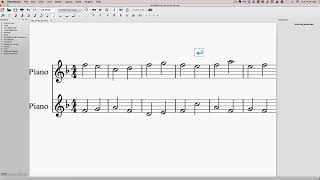
In this instructional segment, J. Anthony Allen outlines the core melodic rules for first‑species counterpoint. He states that any melodic interval larger than a step must be consonant, limiting skips to thirds (minor thirds being the primary option) and allowing fourths or fifths only when they are diatonic (e.g., a B♭ fourth in F major). Leaps of tritones, major sevenths, or minor sevenths are strictly prohibited. A good melodic shape is described as having a clear contour with a single high point placed near, but not at, the final measure. Repetition is limited to at most one repeated note, and the line may contain only one leap overall. The melody must begin and end on the tonic of the key (illustrated in F major). In minor keys, the seventh scale degree should be raised to create a melodic minor leading tone (e.g., G♯ in A minor). Finally, chromatic half‑step motions are to be avoided, keeping the line diatonic. The segment ends with a transition to harmonic (vertical) writing.
Chapters
Rule number one. So we're only talking about melodic intervals here right now. We're going to talk about harmonic intervals, vertical ones, in a minute. So the rules are melodic intervals larger than steps must be consonant. So if we go a step, it can be one of our quote, dissonant intervals. But if we go larger than a step, it has to be a consonant interval, which means a third, a minor third. That's kind of our only option really for a skip. But for a leap, we wouldn't want to leap to a major seventh, for example. That's a dissonant interval. We would want to leap to something like a fifth or even a fourth would be okay, remember, I have a B flat in my key signature over here, so that's a fourth. If I didn't have a B flat, that would be a tritone and that would be a no, no. That would be a definite no, no. No leaps of a tritone. In fact, that's the next rule. Intervals of minor sevenths, major sevenths or tritones are prohibited. So we cannot go up by a tri. We cannot leap by a tritone. We cannot leap by a seventh, major or minor. So that. Those are no no's. Okay, next rule. We want the melody to have a good shape. So that is a very, very, very subjective rule. But what that means is that. Well, let's go back here. Typically, what a good shape means is it's got a contour that we can see. It goes, for example, this one, it goes down and up and down and up. It's got a kind of a rolling wave to it. And then also typically in a good shape, you have kind of one high point. And it's near the end, but not right at the end. So here's our high point. It's our highest note. It's the bar before the end. That's a good place for it. This is a very subjective thing. We'll talk more about that in the future. Not too many repeated notes. You're supposed to only have at most one repeated note. So like, you know, repeated note would be like that. If we had three Ds in a row, that's a. No, no. If you had two Ds in a row, that could be okay. But you can really. You're only supposed to do that once. Another rule is everything should be steps and skips with one leap at most. So no more than one leap is ideally what we want. And that's what we have in both of these here. We have a leap here, and we have a leap Here. So you're supposed to begin and end on tonic. This is first species only kind of a thing. But so we're going to start on an F here because we're in the key of F and we're going to end on an F in both voices and everything. So both melodies. Well, I mean, we're really just talking about a single melody here. So that's to begin and end on the tonic, which in this case is F on the one, the first scale degree. Okay. And then three things to avoid number one, if you're in minor key, if you're doing this in a minor key, you should raise your seventh to the melodic minor. So in the key of A minor, we would have a G sharp. We would raise that to make the strong leading tone, right? So we would use the melodic minor for that, to make it to give us that leading tone in a minor key. In A major key, we don't raise anything. And one more thing. We want to avoid chromatic half steps. That would be like doing this. So chromatic means we're going out of key, right? So. And you can do that. But this would be a chromatic half step. Something like this. That is a chromatic half step where we go just up by half step through a chromatic note. That is not an appealing sound. And that is not okay in first species counterpoint. If we want to get from G to A, we would not want to use a G sharp. In that case, we want to use another note that would work both melodically and harmonically. So we avoid those chromatic half step motions. Okay? So that is kind of the fundamental rules of the melodic writing. Now let's switch to talking about harmonic writing. Here we go.