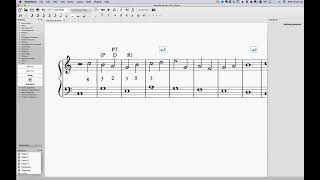
A detailed walkthrough of passing tones in second-species counterpoint, showing how to approach and leave them by step while avoiding parallel octaves. The instructor explains the P-D-R labeling system for non-chord tones, demonstrates interval analysis, and emphasizes that dissonance must fall on unaccented beats, with examples annotated in MuseScore.
Chapters
Okay, let's talk about passing tones. As you can hear, I'm still sick. My voice is very low, but that's okay. I think I feel better than I sound. I think my voice is just screwed up. So let's press on and talk about counterpoint. Okay, so passing tones. So passing tone is what we call a non chord tone that we step through. So we just talked about how whenever we have these non chord tones, we have to approach them by a step and leave them by a step, just like this. B to A to G. So there's a step there and a step there. These are called passing tones because we just pass right through them. So I have a new counterpoint up here. Cantu's firmness on the bottom and a counterpoint on the top. So I just want to go through and label everything again. So let's start with our intervals. So here we have an eight. And another eight. Now, does this work? This actually does not work. This is wrong, because what do I have? I have two eights in a row. That's technically speaking, parallel octaves. Because it's an octave two in a row, it's the same note. But that actually doesn't work. Here's a way around it. Boom. Check that out. We can actually. This is kind of a footnote of a rule in Second Species counterpoint, but we can actually start with a half rest. You can get away with that at the beginning. There's another one that I'm going to do over here where we can end with a whole note on the second to last measure. We almost always end with a whole note on the last measure. I think we have to end on a whole note in the last measure. But on the second to last measure, if it's a leading tone leading up to tonic, which it is here, we can end on. We can stay on a whole note for that whole bar. Those are two rhythm exceptions. So let's avoid the parallel octave by getting rid of that note. So now we have an octave between here and here. Now let's move on. Okay. G to B, that is a third, right? And G to A, that is a second. But that's okay because we're passing right through it. And now we have E to G, which is another third, and that's okay. And E to B, which is a fifth, which is okay by itself. No harm there. Now, one thing I want to do, and this is something that you'll do, if you're doing a full analysis of a counterpoint against a contus firmness is we can label our passing tone. So what we're going to do here, I'm going to label this pt that is a passing tone. And it's allowed for two reasons, because it's stepped in and stepped out. And the other reason is because it's on the unaccented part of the measure. That's why it's allowed. We could also go a step further and label these notes like this. Let's say you put it in parentheses. Okay. Pdr. Preparation, dissonance, resolution. Right. So you don't always label those, but you can sometimes. You'll have to, depending on, like if you're doing some assignment. But. So passing tone. Preparation, dissonance, resolution. Okay, let's keep going. We get up to an A and a C here. So that's going to be a third and an A and a D. That's going to be a fourth. A. No, no. In first species counterpoint. But totally okay in this case because it's passing tone. Let's label our next bar and then we'll go back and do this stuff. So we have a G and an E. So we have a six. And then we have a G and a G. So we have an octave. Okay, let's go back and deal with this D. So this is going to be. A passing tone. So let's label that as such. Wish I could get rid of that little arrow thing. I don't know where that comes from. That's a musescore thing. But let's ignore it for now. And then let's do this again. Copying and pasting. Preparation, dissonance, resolution works. Right? That D has to be on the second half of the measure, or else it doesn't work. If you had something that looked like this, where you had preparation, dissonance, resolution, and the dissonance was on the downbeat. No good. Can't do it. So pdr. All right, let's keep going. Let's just finish this out real quick. So we have F and an A. Oops. Grab one of these. Copy. So that's a third. And then we have an F and an F, and that's an octave. Then we have an E and a G. So that's a third. And then we have an E and an A. That's a fourth, which is allowed. Let's just finish this out. We have a D and a B. So that's a six. And then we have our octave that we want to end on. Right. We always. We still want to end on an octave or a unison. So the only other dissonance here. That's not. That's not. That's not. That's not. That is. So here's another dissonance. So we need to deal with that. That is a passing tone. And let's put all of this stuff on it as well. Preparation, dissonance, resolution. There we go. Okay, so that's how our passing tones work. I think we've nailed that home. Now. There are more types of things we can label, though, in here. Let's look at consonant skips and leaps next.