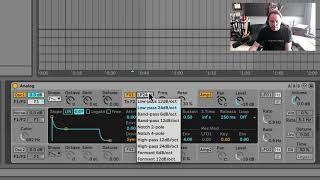
J. Anthony Allen breaks down how analog synthesizers work: three sound sources feed into filters and amplifiers, with routing controls that let you split signals between paths. High resonance on a filter makes a laser-gun sound; noise generators create percussive attacks like snare drums.
Chapters
Okay, so let's zoom in on this sucker. So what we have in analog is two oscillators and then a noise generator. So we have three sound generating things, three oscillators, and they are right here. So you'll notice, as I pointed out before, in analog we have oscillator, filter, amplifier, twice, oscillator, filter, amplifier. But let's just focus on the oscillators for a second here. So we have Oscillator 1 and Oscillator 2. We can turn them off by just clicking this osc. Okay, so now we have no oscillators on, which means we're going to hear nothing. Okay. So I can turn one oscillator on and we're going to hear that sound. Let me turn this filter off just so that we hear it kind of exactly as is. Okay. Now noise is a sound generating thing that we'll see in a lot of synthesizers. Sometimes it's great to put in noise. It can really be shaped to give you a real percussive attack. We see noise when we're programming drum sounds. Like if you want to make a synthesized snare hit, might be a lot of noise, right? So you hear it and you're like, wow, that's really noisy. It sounds like I'm layering noise over it. Well, we are, but what if we did this? See, now we have a nice percussive attack to it. But let's not do that right now. So let's leave noise off and just one oscillator. Okay. So we always want to look at the signal flow when we're looking at any synthesizer. Okay. So the signal flow here is fairly simple, but it can be diverted in interesting ways. So Oscillator 1, this is going to tell us where Oscillator 1 is going to. In general, things are going to go from left to right. Oscillator one is going to go to filter one, which is going to go to amp one. Okay. And oscillator two is going to go to filter two, which is going to go to amp two. However, we can kind of mix things around. See oscillator one, where's it going to go? Filter one or filter two can say all filter one can drag this down all filter two. Or I can say, you know, go 60% to filter one and 40% to filter two. So that's going to send this signal 60% of it to filter one and 40% of it to filter two. Okay. So you can play around with the routing here. Okay. I can say all of it to filter two if I want. So let's send it all to filter one. So now it's going here. Okay, so we Turn on Filter 1, we can set our type of filter, which we'll talk more about shortly, and then we can say, where does this filter go? Right now it's going 100% to filter two. So I'm going to apply two filters to it. Okay, so let's turn on filter two and set something there. We'll just do that kind of a thing, give it a lot of resonance. Talk more about that later. And then amp 2. Okay, so now we're going from here to here to here to here. Okay, so our level is here. Okay, so you hear that little laser gun effect? That's this resonance right here. Resonance gives you that kind of laser gun sound. We'll talk more about how that works later. Okay, so now we're going to amp 2. Now, I believe what's happening here in analog is that filter one always goes to AMP1. So Filter 1 is going to AMP1, but it's also being duplicated here and sent to filter two. So we have. We're duplicating our signal. So both amp1 and amp2 are getting the signal. Okay, then from amp1 and 2, it goes to the LFO section, which is currently off. So it's passing right through there and then going to our master volume. Right. So the signal flow is in general from left to right, oscillator filter, amplifier to the output. But we can mix it around a little bit and play with it through this kind of simple routing in here.