In this lecture, the presenter surveys the foundational ideas of early Western music theory, emphasizing how mathematics shaped musical thought. He begins with Pythagoras, whose work on ratios gave rise to the chromatic scale, and then moves to Boethius, whose treatise introduced the threefold concept of the music of the spheres—musica mundana (the music of the universe), musica humana (the music of the human body and soul), and musica instrumentalis (instrumental music). The speaker explains that all three share the same mathematical principles. He briefly mentions Guido of Arezzo’s contributions to notation, then shifts to the practical musical landscape of the time: Gregorian chant and the development of the eight church modes, early collections of notes drawn from the chromatic scale that prefigure the later major/minor system. Throughout, the lecturer adopts an informal, enthusiastic tone, encouraging listeners to explore the music‑of‑the‑spheres concept further.
Chapters
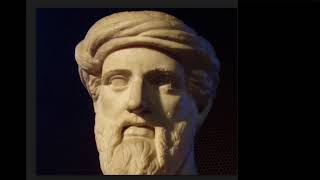
Okay, let's move on and talk about what music theory was happening at the time, or what music theory was doing at the time, more accurately. Now, I'm not going to go into huge amounts of detail on music theory in this class. However, a good handful of it just can't be avoided. We have to talk about it. Everything in music theory at this point in history was built around one or perhaps two people. The one that's for sure is Pythagoras, this guy we're looking at here. So Pythagoras was essentially a mathematician, but remember that math is, er. Music is still a math at this point. So music is regarded as a relationship of ratios, mathematical equations. That's how music was thought about. And, you know, if you think about it, that's still true. Music is all about ratios. We make intervals out of ratios, we make rhythms out of ratios. It's all actually very mathematical. But we don't work with music typically in this mathematical way anymore. But back then they did. So Pythagoras gets us pretty much everything we know about music theory at this point, most notably the chromatic scale, right? So he kind of figures out the chromatic scale. But there's another guy around this time who builds on the work of Pythagoras named Boethius. Boethius wrote a number of treaties, including one called. I'm just going to read the translated version. I believe it's Latin or Italian. I think it's Italian. But it translates to the fundamentals of music. And in that we get our first glimpse at something that became known and is still known as the music of the spheres. So the music of the spheres is a really fascinating topic. I've read a whole book on music of the spheres a couple years ago, and I don't want to go into too much detail on it because it's not very factual. It was a theory about music back at the time, and I just find it really fascinating because it has to deal with music and astronomy and a little bit of spirituality is in there. And a little bit of like time, like time travel kind of. It's really weird. But essentially, I'll give you the Cliff Notes version. Cliff Notes version is there are three different kinds of music. There's something called music mundana, which is the music of the universe. Okay. So that's the music that if you imagine all the planets as they rotate, make some kind of celestial sounds, right? We can't hear it. It's not something that we can hear. This kind of music is not something that humans can hear. This is more on the level of music of the gods. Okay. The second type of music was called musica humana, or human. So music for humans. And this was the music made by the body and the soul. So this wasn't like music you're playing. This is music that occurs all around us all the time. The soul music, but not like soul. Not like James Brown soul music, but like music of the soul. And I believe the case is that we can't hear this either, but not because it's not for our ears. We actually can hear it, but it's always around us and always going. So we've learned to tune it out. I think that's how the theory behind Musica humana worked. And. And then there's the third kind of music, which was musica instrumentalis. Instrumental music. That's the kind of music we make and play. It's the lowest kind of music, and it's the only kind that we can really hear. We make it with instruments or with voices. But all three different forms of music all obey the same mathematical rules about the ratios and what's happening. Right. So I encourage you to look that up, do a little homework on music of the spheres, if you want to learn more about that. It's a fascinating study. Oh, the time travel bit that. It's not really time travel. That has to do with, like, the. The months of the year. There's a correlation between months and pitches that can suggest weird. You can build harmonies of months, let's just put it that way, which causes weird things to happen. Okay, so so far in this period, not all at the same time, but roughly within the thousand years or so that we're talking here, we have Boethius, we have Pythagoras, and we have Guido. Okay, we talked about Guido, and we talked about notation. So between those three people, we start to get firmer realization happening in the primary musical form at the time, which was still Gregorian chant, or just chant. Let's just call it chant because the word Gregorian is not exactly correct. So that leads us to the church modes. So the church modes were a number. Were a group of scales. Right. So we still don't quite have, like, the major and minor scale yet. Right. We have the chromatic scale, and we have a couple. And. Well, what we're gonna get with what are called the church modes is a couple of collections of notes within the chromatic scale that sound good. Right. So these are notes that sound good together. And there. There are eight of them. And you might be thinking. Wait, wait. I took your music theory class. There are only seven modes. Oh, just hold your horses. So they have the chromatic scale, and they say, okay, here are eight groups of notes that sound good together. Eventually, this is going to evolve into the major and minor scales that we know now, but when it first was realized, it was a group of eight. Let's go into a new video and let's talk about that right now.